
Dr. Johannes Schmees

Junior Researcher Media Law & Algorithms

Johannes Schmees worked at Leibniz Institute for Media Research | Hans-Bredow-Institut (HBI) since June 2019 in the research program “Regulatory Structures and the Emergence of Rules in Online Spaces” from June 2019 to the end of May 2023. There, he supervised the Volkswagen-Foundation ‘s interdisciplinary project “Deciding About, By and Together with Algorithmic Decision Making Systems”. His dissertation, which was written at the HBI, was published in April 2024 by Duncker und Humblot Verlag and is available in its entirety as open access.

Johannes Schmees studied law at the Ruprecht-Karls-University Heidelberg, Geneva and the University of Münster with a focus on information, telecommunications and media law.

He is particularly interested in public media and constitutional law in context with artificial intelligence, with which he also dealt with in his dissertation project.

Last update: 24.09.2026

Works by Dr. Johannes Schmees

Zwei Jugendliche, zu sehen von hinten oben, sitzen auf einer Mauer und blicken auf ein Handy
New DFG Research Project

Safeguarding Epistemic Trust in Adolescents: Conceptual Approaches and Policy Options

The interdisciplinary DFG project, “SETA: Protecting the Epistemic Trust of Adolescents: Conceptual Approaches and Policy Options,” conducted in collaboration with the Weizenbaum Institute, examines the state’s obligation to protect the epistemic trust of 13- to 17-year-olds without infringing on freedom of expression and information.

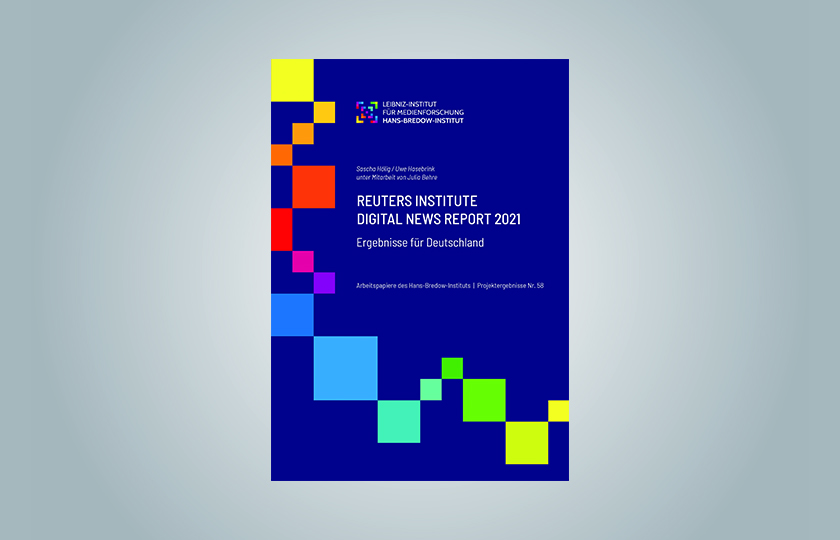
Cover des Arbeitspapiers Reuters-Bericht 2021
Report for Download

Reuters Institute Digital News Report 2021

The Reuters Institute Digital News Report, which provides an international comparison of news consumption, is being published for the tenth consecutive year.

Cover der Zeitschrift der Leibniz Gemeinschaft - Ausgabe 2/2026 zum Thema "Medizin"
Click Consultation

Consultation with Dr. Insta

The latest issue of the Leibniz Association’s magazine, which is part of the Science Year 2026, focuses on the topic of “Medicine.” Claudia Lampert, head of the Health Communication research group at the HBI, is interviewed about health influencers.

Blätter und bunte Zettel mit den Ergebnissen der Arbeiten von Gruppe 4, Gruppe 2 usw.
Article on the Media Research Blog

How Politically Empowered Do Young People Feel?

In a current project by Leonie Alatassi, students explore what political participation means to them, how it can be encouraged, and what barriers stand in the way. The first workshops show that many young people are eager to get involved. However, they need not only information, but also concrete support and opportunities to try things out and gain experience.

Bild aus der Research Clinic: eine Gruppe Menschen sitzt im Kreis und diskutiert
Report from the Research Clinic

Hype vs. Doom – How Can AI Reporting Become More Nuanced?

Public debates about AI often oscillate between technological utopianism and dystopian visions of the future. How can journalists report on a topic that is both ubiquitous and difficult to grasp in a nuanced and balanced way? A Research Clinic at the HBI explored the challenges of reporting on AI and discussed possible ways to address them.

Cover
Open Access Publication

German Public Broadcasting Corporations in the Age of Streaming Platforms and AI

In her Friedrich Ebert Foundation publication project, Magdalena Stratmann describes how public service broadcasting in Germany addresses the challenge of fulfilling its legal mandate amid drastically changed conditions in the digital information ecosystem.

Cover der Studie
Recently Published!

Exploring GPT Representation of Journalistic Culture

The study by Prof. Dr. Wiebke Loosen et al. examines how large language models (LLMs) such as ChatGPT can reflect journalistic value systems. To this end, the GPT-4o model was asked to answer questions from the “Worlds of Journalism Study,” which explores perceptions of journalistic roles, theories of knowledge, and ethical principles.

Historische Aufnahme des hr-Funkhauses am Dornbusch aus den 50ern
Media History Project

The History of the Regional Public Broadcasting Corporation of the Federal State of Hesse in the Postwar Period

In January 2029, the Regional Public Broadcasting Corporation of the Federal State of Hesse (Hessischer Rundfunk) will celebrate its 80th anniversary. To mark the occasion, Dr. Hans-Ulrich Wagner is conducting scholarly research on its origins. His research focuses specifically on corporate history, personnel decisions, and programming policy in the postwar period.

Cover Arbeitspapier Nr. 84
Brief Report in English

Babies and Toddlers in Monetised Social Media Profiles

Stephan Dreyer, Claudia Lampert, and Kira Thiel published an English summary of their study on babies and toddlers in family-influencing content. They present their findings on how babies and toddlers (ages 0–5) are depicted in German-language, commercially oriented social media profiles on Instagram, TikTok, and YouTube.

Cover der Zeitschrift KIR
Published on Beck-online

Freedom of Expression in the Age of AI

In their article in a journal on artificial intelligence and law, Prof. Dr. Wolfgang Schulz and Moritz Wiechert analyze the first German case law on automatically generated content. In doing so, they highlight the fundamental challenges facing traditional freedom of expression law in the age of AI.

Cover der Publikation "Avoiding the News But Still Feeling Connected? The Role of News Use and Avoidance Practices in Different Public Connection Repertoires"
Recently Published!

Avoiding the News But Still Feeling Connected?

How are different forms of news avoidance related to various types of individual public connection? The article by Julia Behre, Lisa Merten, and Uwe Hasebrink suggests that avoiding the news does not necessarily mean turning away from public life.

Eine Frau im Gespräch bei der ARD-Dialogaktion "Was Deutschland verbindet.
Post on the Media Research Blog

Staying in Conversation Despite Different Opinions? Two Examples

Whether at a family dinner or during a lunch break, differing opinions are a part of everyday life. But what happens when people continue to engage in conversation despite holding controversial views? This article introduces the dialogue formats “What Unites Germany” and “Context Collapse” and shows how such spaces for interaction can contribute to the formation of shared opinions and social cohesion.

1 2 3 … 31

Page 1 from 31

Newsletter

Information about current projects, events and publications of the institute.

Subscribe now