Growing Up in Digital Media Environments

How are the advancing digitalisation and deep mediatisation changing the way children and young people grow up? What role do social media, online platforms, and artificial intelligence play in identity development, education and social participation? And how can safe online spaces in which young people gain experiences be designed for young people?

The Research Area “Growing Up in Digital Media Environments” investigates how young people use digital and AI-powered media in their everyday lives, what opportunities and risks arise from this use, how they cope with the challenges of the digital world, and what implications this has for media education, children’s rights, and the protection of children and young people in digital media environments. A key characteristic of the research group is its interdisciplinary approach that brings together perspectives from communication studies, the social sciences and legal studies.

The research group pays particular attention to the changes brought about by data-driven systems and artificial intelligence and their implications for growing up in increasingly digitalised societies. In the Youth Lab (Y-Lab), it works together with children and young people in a participatory way: together, they explore new technologies and analyse experiences, expectations and patterns of use. Combined with established research methods, this approach provides a deeper understanding of the significance of digital media and AI-powered technologies for young people.

The planned Observatory for Young People in Digitised Societies will be designed to establish a long-term framework for research and monitoring, enabling the analysis of digital transformation and their consequences for young people. It draws together interdisciplinary findings from relevant studies and projects, including the group’s own research, identifies emerging developments and trends, and provides scientifically grounded knowledge for policymakers and society, supporting the further development of media education and the protection of children and young people in digital media environments.

Research group leaders: Dr. Stephan Dreyer and Dr. Claudia Lampert

Overview

Last update: 16.09.2026

Blog Articles, News, Projects, Publications, Podcast Episodes

Portrait von Stephan Dreyer
Protection of Children and Young People

EU KIDS Act – Proposed Social Media Regulation

In his statement for the Science Media Center, Stephan Dreyer explains that with the EU KIDS Act, the European Commission is proposing "nothing less than a comprehensive EU regulatory framework for the protection of minors in the digital space." The draft regulation aims to enforce new requirements for digital services to better protect children and adolescents.

Portrait von Prof. Dr. Matthias Kettemann
Expert Opinion for the SMC

Should AI Development Be Slowed Down?

In his statement for the Science Media Center, Matthias Kettemann explains that the proposal by Anthropic CEO Dario Amodei for a controlled slowdown in current AI development should be taken more seriously than previous calls for a “pause.” Unlike those previous calls, Amodei's proposal is not vague.

Portrait Azade Kakavand
Interview on radioeins

How the AfD Is Using TikTok for Its Election Campaign

On 6 September, Saxony-Anhalt held elections for a new state parliament. Dr. Azade Kakavand examined the parties’ presence on TikTok in the run-up to the election and explains on the programme Das Medienmagazin (radioeins, rbb) how the AfD was able to achieve significant reach on TikTok.

Ein Mädchen schaut gebannt in einen Laptop. Hinter ihr ist ein Bücherregal.
Digital Protection of Children and Youth

Expert Commission Presents Final Report

The expert commission on "Protecting Children and Youth in the Digital World" submitted its final report to Federal Minister for Family Affairs Karin Prien. The report contains the commission's findings from the past year, including an assessment of the current situation, recommendations for action, and the results of the child and youth participation process and the strategic foresight process. The commission incorporated Claudia Lampert’s expertise into its work.

Screenshot aus der Sendung ZDF heute vom 4.9.2026. Im Bild: Moderatorin Alica Jung (links) und Matthias Kettemann (rechts im Bildschirm).
Tricky Accessories

Should Smart Glasses Be Banned?

Smart glasses, which are data glasses equipped with a camera, AI, and an internet connection, raise new questions about the protection of personal rights. However, according to Matthias Kettemann, new bans are not necessarily needed. Rather, existing laws must be enforced more consistently. He explaines this on the ZDF heute program.

Situation im Workshop: an einem langen Konferenztisch arbeitet eine Gruppe Forschender konzentriert an ihren Laptops
International Workshop at the HBI

Visitors from Brisbane!

Last week, eleven researchers from Australia and Germany worked intensively together at the HBI on the “Mapping Polarization in News Media Content” project, which compares climate reporting in both countries. Among other things, they conducted further analyses and prepared conference papers and publications.

Tobias Mast
Expert Opinion for the SMC

Stricter EU Rules for ChatGPT

The European Commission has classified ChatGPT as a very large online search engine under the Digital Services Act (DSA). Tobias Mast considers this classification reasonable. In his statement for the Science Media Center, he points out that the consequences depend on how the DSA’s requirements, which were originally developed for different types of services, are applied to AI chatbots.

Svea Eckert mit Kopfhörern schaut nachdenklich in die Kamera, hinter ihr sind Arbeits-Laptop und Bildschirm mit Text zu sehen
Podcast Episode

Artificial Intelligence Everywhere Now?

On the Deutschlandfunk podcast, which translates to "After the Editorial Deadline," Svea Eckert discusses why artificial intelligence is suddenly a hot topic everywhere and the logic behind the media coverage.

Portrait von Prof. Dr. Matthias Kettemann
Expert Opinion for the SMC

Record Fine and New Social Media Guidelines for Meta

After 29 U.S. states filed a lawsuit against the media conglomerate Meta, the Science Media Center asked Matthias C. Kettemann to evaluate whether the changes made by the platforms are sufficient to ensure they are no longer harmful. Kettemann was also asked to discuss potential difficulties with age verification and the implications of this lawsuit for future legal actions.

Eine Junge Frau liegt, die Beine hoch an einer Klinkerwand, und schaut auf Ihr Handy
Joint DFG Project with the Weizenbaum Institute

Research on the Impact of Disinformation on Democratic Participation Among Young People

Hamburg, 27 August 2026. How do digital media influence young people’s trust in information and their democratic participation? This is the focus of the DFG-funded research project “SETA – Safeguarding Epistemic Trust in Adolescents: Conceptual Approaches and Policy Options.” The project is part of the DFG Priority Programme "Rethinking Disinformation (Re:Dis)."

Zwei Jugendliche, zu sehen von hinten oben, sitzen auf einer Mauer und blicken auf ein Handy
New DFG Research Project

Safeguarding Epistemic Trust in Adolescents: Conceptual Approaches and Policy Options

The interdisciplinary DFG project, “SETA: Protecting the Epistemic Trust of Adolescents: Conceptual Approaches and Policy Options,” conducted in collaboration with the Weizenbaum Institute, examines the state’s obligation to protect the epistemic trust of 13- to 17-year-olds without infringing on freedom of expression and information.

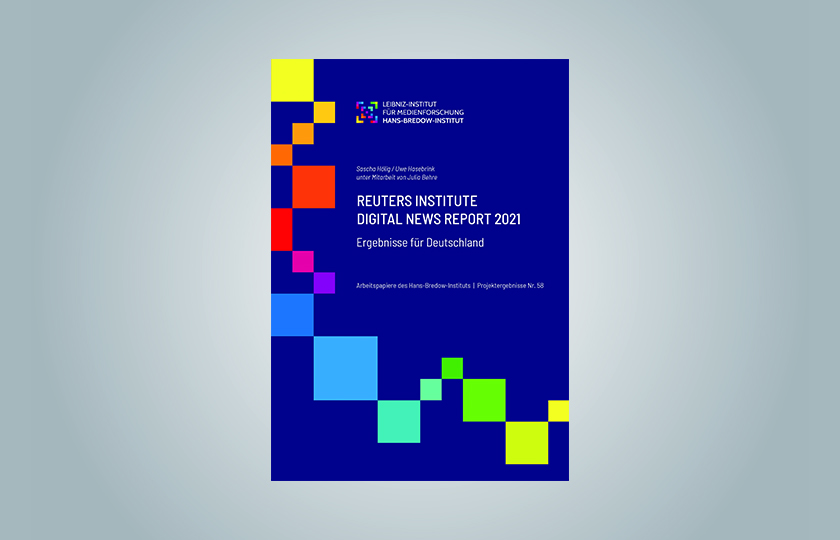
Cover des Arbeitspapiers Reuters-Bericht 2021
Report for Download

Reuters Institute Digital News Report 2021

The Reuters Institute Digital News Report, which provides an international comparison of news consumption, is being published for the tenth consecutive year.

1 2 3 … 43

Page 1 from 43

Newsletter

Information about current projects, events and publications of the institute.

Subscribe now