Growing Up in Digital Media Environments

How are the advancing digitalisation and deep mediatisation changing the way children and young people grow up? What role do social media, online platforms, and artificial intelligence play in identity development, education and social participation? And how can safe online spaces in which young people gain experiences be designed for young people?

The Research Area “Growing Up in Digital Media Environments” investigates how young people use digital and AI-powered media in their everyday lives, what opportunities and risks arise from this use, how they cope with the challenges of the digital world, and what implications this has for media education, children’s rights, and the protection of children and young people in digital media environments. A key characteristic of the research group is its interdisciplinary approach that brings together perspectives from communication studies, the social sciences and legal studies.

The research group pays particular attention to the changes brought about by data-driven systems and artificial intelligence and their implications for growing up in increasingly digitalised societies. In the Youth Lab (Y-Lab), it works together with children and young people in a participatory way: together, they explore new technologies and analyse experiences, expectations and patterns of use. Combined with established research methods, this approach provides a deeper understanding of the significance of digital media and AI-powered technologies for young people.

The planned Observatory for Young People in Digitised Societies will be designed to establish a long-term framework for research and monitoring, enabling the analysis of digital transformation and their consequences for young people. It draws together interdisciplinary findings from relevant studies and projects, including the group’s own research, identifies emerging developments and trends, and provides scientifically grounded knowledge for policymakers and society, supporting the further development of media education and the protection of children and young people in digital media environments.

Overview

Last update: 09.10.2026

Blog Articles, News, Projects, Publications, Podcast Episodes

Cover
Austria's Communications Platform Act

Some Comments on Austria’s Draft Communications Platforms Act

Matthias Kettemann, Gregor Fischer and Felicitas Rachinger analyse the draft of the new Austrian Communications Platforms Act in the latest Graz Law Working Paper.

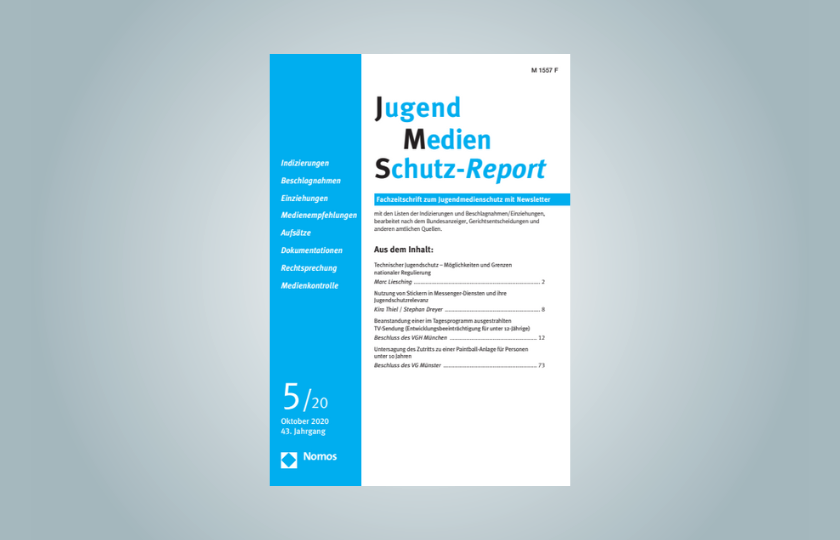
Cover der Zeitschrift Jugend Medien Schutz Report Ausgabe 5 / 2020
Protection of Minors in Messaging Services

Use of Stickers in Messenger Services and Their Relevance to Youth Protection

In the Youth Media Protection Report, Kira Thiel and Stephan Dreyer provide an overview of how children and adolescents use stickers in messaging apps and also discuss the associated risks.

Cover
Accompanying Text to Wolfgang Borchert

How Wolfgang Borchert’s “Draußen vor der Tür” Came to the Radio

Wolfgang Borchert's " Draußen vor der Tür [Outside the Door]" is a protest cry against the destructive power of war. After its first broadcast in 1947, it became the radio's biggest audience success in the post-war era. Hans-Ulrich Wagner contributed to the extensive booklet on the history of its creation.

Portrait Matthias Kettemann
Hate Speech Online

Comments on Austria’s Draft Communications Platform Law

On the Sustainable Computing Lab Blog, Matthias Kettemann analyses Austria's new Communication Platform Act. Although the Austrian legislator is already many things right with this "milestone" for more online protection but it still has a few edges.

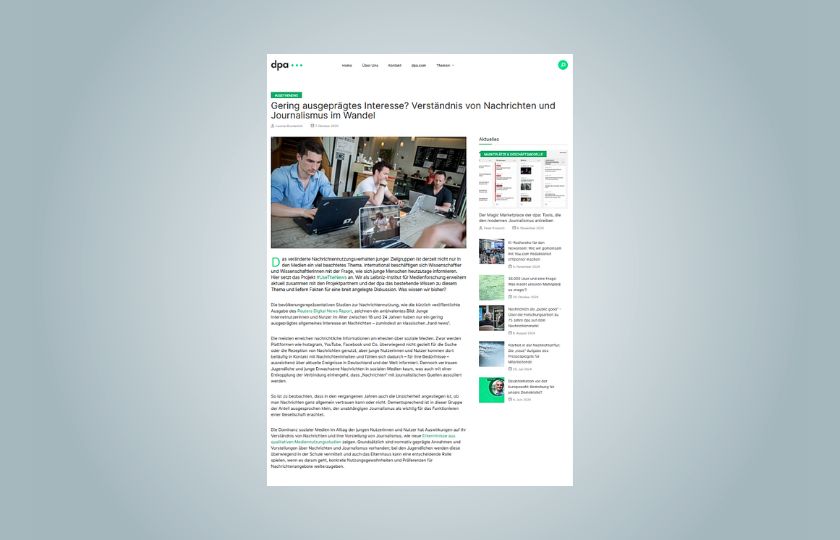
Vorschau eines Artikels auf dem Innovationsblog der dpa:
dpa Innovation Blog

In an article on the  innovation.dpa.com, Leonie Wunderlich writes about the first results of our project "Use The News" on news usage in the digital age.

Youth Media Protection

Not for the Faint Hearted?! How the Federal and State Governments Plan to Modernize Youth Media Protection

The Law on the Protection of Minors from Harmful Media is too old and calls for modernisation. In the current issue of the journal Kinder- und Jugendschutz in Wissenschaft und Praxis, Stephan Dreyer gives an overview of the planned changes, their points of friction and to what extent these changes can be sustainable.

Cover der Zeitschrift Computational Communication Research_Teaser
Open Access

How Document Sampling and Vocabulary Pruning Affect the Results of Topic Models

In the new issue of the journal Computational Communication Research, Dr. Gregor Wiedemann writes together with three other authors about how Topic Modeling could be simplified. This article answers the question whether and how Topic Models can be calculated reliably and without quality loss on smaller samples for the analysis of the population.

Publikation "
Journalistic Coverage of COVID-19

Ethnographic Insights into the Science Media Center and Its Response to the COVID-19 Outbreak

In einer Sonderausgabe des Journal of Science Communication, die sich ausschließlich mit der Kommunikation im Zusammenhang mit COVID-19 befasst, schreibt Irene Broer über die interredaktionelle Reaktion des Science Media Center Germany (SMC) auf den Ausbruch der Pandemie.

Six stylized figures in a video conference window with one figure highlighted in a different color and icons for microphone, camera, participants, chat, and more below.
Blogpost

Who is Zoom to Judge?

Why Engaging in Content Governance is Not a Good Idea for the Successful Video Conferencing Platform.

Cover
Contribution to Anthology

Taking Ingolf Pernice Seriously

In the anthology "Don't Give Up, Stay Idealistic and Try to Make the World a Better Place. Liber Amicorum for Ingolf Pernice", Matthias C. Kettemann describes how the legal scholar Ingolf Pernice has influenced his research on normative order and what normative order on the Internet is all about.

Cover
Accompanying Text to Paul Celan

Of the Strange Celan Sound and an Art-Creating Poetry Voice

Paul Celan is one of the most important German-speaking poets and had a very special way of reciting his poems. In this compilation, the original recordings can be heard for the first time. For this occasion, Hans-Ulrich Wagner has written a detailed accompanying text with background information on Celan's life, work and recitations.

1 … 35 36 37 38 39 … 44

Page 37 from 44

Newsletter

Information about current projects, events and publications of the institute.

Subscribe now