Health Communication

What role do digital media play in health-related behaviour? How can communication science contribute to improving health communication?

The “Health Communication” research group focuses on changes in health-related communication processes in the context of ongoing digital transformations. It examines health-related communication phenomena in digital environments—ranging from health and “sickfluencers” on social media, health apps, serious games, and games for health, to the use of AI-supported applications in healthcare settings.

The focus is on the effects of these developments on health-related communication processes. This includes, among other things, questions regarding the influence of these technologies on trust in health-related information, the attribution of medical expertise, the quality of the doctor-patient relationship, and health-related attitudes and behaviors—for example, with regard to processes of shared and informed decision-making.

In addition, the research group examines the health-related function of automated communication (e.g., chatbots) and the question of how this affects mental health—particularly among adolescents and young adults.

Head of the research group: Dr. Claudia Lampert

Overview

Leaders

Last update: 16.09.2026

Blog Articles, News, Projects, Publications, Podcast Episodes

Martin Fertmann
Incumbents and Social Media

Can Twitter ban Trump?

In their post on the “Junge Wissenschaft im Öffentlichen Recht” (Young Scholars in Public Law) blog, media law experts Martin Fertmann and Keno Potthast discuss whether Donald Trump’s Twitter ban marks a turning point in the previously privileged treatment of public officials on digital platforms.

Silhouettes of three people in front of a large American flag
Polarization in the US

Democracy at Stake: The Capitol Siege as a Digital Crisis?

The attack on the institutional heart of one of the oldest democracies of the world was a major shock, for the United States and democracies all over the world. How were social media conducive to the Capitol siege and what should we learn from it?

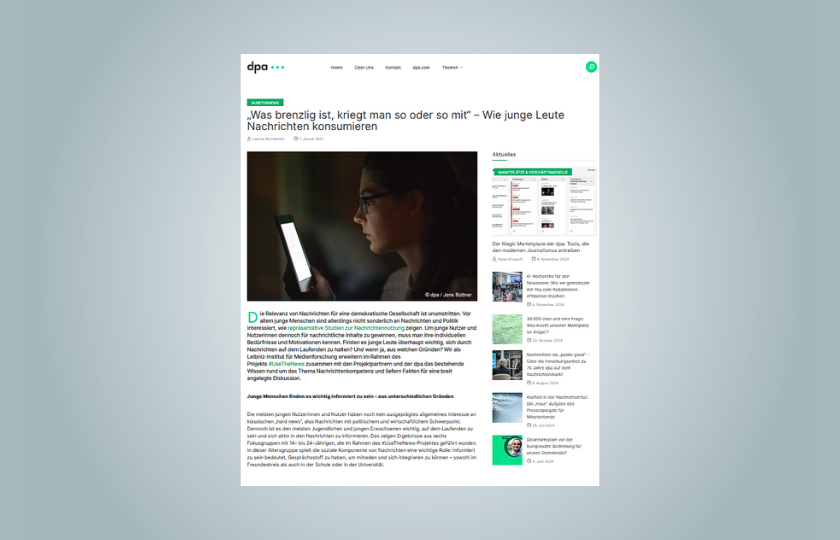
Vorschau des Artikels "Wie junge Leute Nachrichten konsumieren" auf dem Innovationsblog der dpa
dpa Innovation Blog

How Young People Consume News

Leonie Wunderlich writes about young people's news consumption in dpa's Innovation Blog. The article is based on results from our #UseTheNews project.

Daten auf einem Laptop. Quelle: Lukas Blazek, Unsplash
Telemedicus Article

State Media Authority v. Health-Related Google Knowledge Panels

In a guest article for Telemedicus, Martin Fertmann, Wolfgang Schulz, and Stephan Dreyer discuss whether collaborations between health authorities and online intermediaries are illegal.

Eine Frau liest eine Zeitung an einem Bahngleis.
Women and News

Women and News: An Overview of Audience Behaviour in 11 Countries

In “Women and News: An Overview of Audience Behavior in 11 Countries,” Julia Behre and Dr. Sascha Hölig share their findings from the 2020 Reuters Institute Digital News Report on women's news consumption in Germany.

Cover
Open Access

Media and Social Cohesion

The Research Institute Social Cohesion (RISC), in which the HBI is involved with five projects, has published its first publication. The anthology presents contributions on issues of social cohesion from all eleven German institutes and thus offers a first interdisciplinary look at this highly topical field of research.

Portrait Matthias Kettemann
Research Sprint Overview

When Scholars Sprint, Bad Algorithms Are on the Run

In the first research sprint of the project "Ethics of Digitalisation", funded by the Mercator Foundation, international researchers looked at the use of AI in the moderation of online content. Matthias Kettemann and Alexander Pirang provide an overview of the key findings in this blog article.

Portrait Matthias Kettemann
Facebook's Deletion Obligations in the Glawischnig Case

No “Censor for the World”

In an article on the Verfassungsblog [Constitutional Blog], Matthias C. Kettemann and his co-authors clarify misunderstandings in connection with the "Glawischnig ruling" of the Austrian Supreme Court.

Cover
Book Chapter

Hate Speech and Counter-Speech in Commentary of Mass Media Coverage

In a contribution to the anthology "Social Media", Gregor Wiedemann and Cornelia Fedtke examine the interplay between hate speech and counter speech on social networks. The authors propose a model for computer-aided critical discourse analysis.

Portrait Amélie Heldt, Matthias Kettemann
Article on Verfassungsblog

Why Platforms Struggle with Ensuring Data Access for Academics

In their article on the Verfassungsblog [Constitutional Blog], Amélie Heldt, Matthias C. Kettemann and Paddy Leerssen write about the difficulties of gaining access to platform data as researchers.

Cover der Publikation "The Third Better Internet for Kids Policy Map"
Third Edition

On November 30, 2020, the third edition of the “Better Internet for Kids” Policy Map study was presented at the Safer Internet Forum. In addition to the HBI, TU Dublin also contributed to the study, which was commissioned by the European Commission.

Cover
Open Access Article

Block, Hide or Follow

In this paper, Lisa Merten analyses how users curate their news consumption on social media by specifically following or blocking news accounts.

1 … 34 35 36 37 38 … 44

Page 36 from 44

Newsletter

Information about current projects, events and publications of the institute.

Subscribe now