
Media History

The “Media History” research group examines the role of communication and the media in social and societal processes from two perspectives within the history of media and communication – on the one hand, as communication in the past, and on the other, as communication about the past.

In the first case, media providers, communicators and communicative processes are examined in terms of their significance for historical processes of transformation. One example of this is the project on the history of Hessischer Rundfunk in the post-war period.

In the second instance, studies are being carried out on the valuation of the past, based on the fundamental changes in the constellation of actors and communicative practices in digital interactive media. This research into practices of remembrance and a ‘digital media history’ is being carried out in close collaboration with the Leibniz Research Network ‘Value of the Past’ in its 2nd phase (2025–2029) and Research Group 3 ‘Participation and Appropriation’, which is part of it.

Head of the research group: Dr. Hans-Ulrich Wagner

Photo by Pablo García Saldaña on Unsplash

Overview

Last update: 16.09.2026

Blog Articles, News, Projects, Publications, Podcast Episodes

Gefährdungsatlas der Bundesprüfstelle für jugendgefährdende Medien
Recently released!

Risk Atlas Published by the Federal Review Board for Media Harmful to Minors

The "Gefährdungsatlas [Risk Atlas]" of the Federal Review Board for Media Harmful to Minors helps to navigate through new media phenomena and the associated challenges. Stephan Dreyer is one of the authors.

Cover der Publikation "Künstliche Intelligenz als Richter"
Computer und Recht

Artificial Intelligence as a Judge

Stephan Dreyer and Johannes Schmees examine the challenges and problems that arise in the automation of complex (state) decisions in their article in Computer und Recht using the example of court decisions.

Cover
International Law and Internet Governance

In his contribution to the Völkerrechtsblog [International Law Blog], Matthias C. Kettemann describes how international law and Internet governance protect the future of the Internet.

Cover
Visions for an Inclusive Internet Governance

Many Words. Many Nets. Many Visions

This collection presents 30 critical visions for a non-discriminatory internet governance. The editors Katharina Mosene and Matthias C. Kettemann want to broaden the debates regarding the design of future network policies with perspectives beyond the mainstream.

Cover
PDF available for Download

Busted! The Truth about the 50 Most Common Internet Myths

What is actually true about the internet? This edited volume examines 50 widespread myths about the internet and presents what we actually know about the online world.

Cover
Working Paper Available as Download

Problems and Potentials of the NetzDG

The HBI participated in the discussion on the Network Enforcement Act (NetzDG) with five expert reports, some in German and some in English. A working paper available for download now gathers these texts by Wolfgang Schulz, Matthias C Kettemann and Amélie Pia Heldt.

Cover
Visions for a Non-Discriminatory Internet Governance

Critical Voices, Visions and Vectors for Internet Governance

In the new issue of the research magazine encore, Katharina Mosene and PD Dr. Matthias C. Kettemann present five visions for a discrimination-free Internet.

Cover
Download Free of Charge

Towards a Global Framework for Cyber Peace and Digital Cooperation

Matthias C. Kettemann, together with Wolfgang Kleinwächter, Max Senges and Katharina Mosene, has published an anthology in which central perspectives on the future of Internet regulation can be found.

Portrait Matthias C. Kettemann
Facebook Must Delete Hate Posts

Glawischnig-Piesczek and the Dangers of National Jurisdiction Conflicts on the Internet

Facebook can be forced to delete hate postings worldwide. Matthias Kettemann and Anna Sophia Tiedeke assess this decision of the European Court of Justice in their article on the constitutional blog.

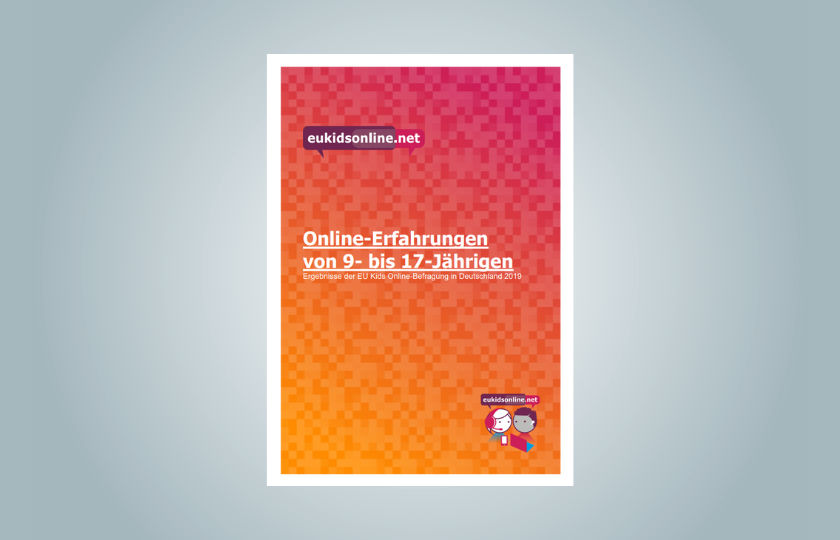
Cover Studie Online-Erfahrungen von 9- bis 17-Jährigen
Results of the EU Kids Online Survey

Online Experiences of 9- to 17-Year-Olds

In this study, Uwe Hasebrink, Claudia Lampert, and Kira Thiel describe how children and adolescents in Germany use the Internet, what negative experiences they encounter online, and how they cope with these experiences. These are the results of a representative survey conducted in 33 countries by the European research network EU Kids Online.

Cover
Diversity Report 2019

News Interest and News Usage in the Digital Media Environment

In the Diversity Report 2019 of the Media Authorities, Uwe Hasebrink and Sascha Hölig write about the news usage habits of Internet users.

Cover der Publikation
Handbook Published

Research Handbook on Human Rights and Digital Technologies

In a digitally connected world, the question of how to respect, protect and implement human rights has become unavoidable. This contemporary Handbook offers new insights into well-established debates by framing them in terms of human rights. It examines the issues posed by the management of key Internet resources, the governance of its architecture, the role of different stakeholders, the legitimacy of rule making and rule-enforcement, and the exercise of international public authority over users.

1 … 38 39 40 41 42 43

Page 40 from 43

Newsletter

Information about current projects, events and publications of the institute.

Subscribe now