Opinion Formation

The “Opinion Formation” research group investigates how people can form their own independent opinions and what is required to make this possible on the part of lawmakers, society, the media, and online platforms.

Public opinion does not emerge in a single place or through a single actor. It emerges from a complex interplay among citizens, the media, platforms, politics, academia, civil society, businesses, and, increasingly, automated systems.

All of these actors pursue different goals, operate under different conditions, and influence in various ways which issues gain visibility and how they are evaluated.

Digitalization, platformization, and the use of artificial intelligence are raising classic questions about the democratic public sphere anew.

  • What is needed for people to form opinions freely and with full knowledge of the facts?
  • How do platforms change the visibility of information?
  • What are the consequences of disinformation, misinformation, and targeted manipulation?
  • And what responsibilities do the media, platforms, the state, and society bear?

Photo by Annie Spratt/Unsplash

Overview

Last update: 24.09.2026

Blog Articles, News, Projects, Publications, Podcast Episodes

KI-generiertes Bild einer Schaufensterpuppe in sonniger Einkaufsstraße mit Passant*innen
Expert Opinion for the KJM

Labeling of Edited (Influencer) Photos

Must, should, may digitally edited photos in social media be labeled? On behalf of the Commission for the Protection of Minors in the Media (KJM), the HBI is investigating the necessity of a legal labeling requirement for edited photos and videos.

Cover of the journal "Deutsche Jugend" 7-8/2024
Article in the Journal deutsche jugend

Cannot Be Reached with News Anymore?

Leonie Wunderlich and Sascha Hölig published the findings of a study that focused on the now quite large group of young people who are not very interested in news in an article called "Lost for News? Ten Insights into Young People Who Are Not Very Interested in News” in the journal deutsche jugend.

People walk across a zebra crossing to the left and right
Renewed BMBF Funding

Research Institute Social Cohesion Enters Second Funding Phase

The Federal Ministry of Education and Research (BMBF) continues its funding of the Research Institute Social Cohesion (RISC) with its eleven sections. The Hamburg RISC section at the Leibniz Institute for Media Research | Hans-Bredow-Institut is analyzing the interplay between media and social change in several projects.

Altmodischer schwarzer Telefonhörer mit Schnur auf grauem Grund
Call for Papers

M&K Special Issue “Datafication of Communication”

For a special issue on "The Datafication of Communication – New Methodological Approaches and Challenges" in our journal "Medien & Kommunikationswissenschaft" (Media & Communication Studies), we invite submissions in German and English. Guest editors are Julia Niemann-Lenz, Tim Schatto-Eckrodt, Emese Domahidi and Merja Mahrt.

Wiebke Loosen
3sat Program in Media Library

What Do I Need to Know? Wiebke Loosen on “scobel”

Wiebke Loosen talks about Kant's philosophical question “What can I know?” as well as about fake news, journalistic conventions and what is worth arguing about in the science TV magazine “scobel” on 3sat.

Wolfgang Schulz
Guest Commentary on Legal Tribune Online

Federal Administrative Court on “Compact”

In his guest commentary on Legal Tribune Online (LTO) on 22 August 2024, Wolfgang Schulz explains the “delicate balancing act” between protecting the rule of law and ensuring the freedoms guaranteed by fundamental rights, which the decision of the Federal Administrative Court of 14 August 2024 regarding the so-called “Compact” ban has achieved.

Junge Erwachsene im Klassenraum vor Laptops
Cooperation between German Internet institutes

Working Together for Young Scientists in Digitalization Research

Germany's internet institutes are strengthening their collaboration. The Bavarian Research Institute for Digital Transformation (bidt), the Center for Advanced Internet Studies (CAIS), and the Weizenbaum Institute for the Networked Society (WI) have included the HBI in their academic career advancement program.

Buchcover "Sozialer Zusammenhalt vor Ort"
From the Research Institute Social Cohesion

Social Cohesion on the Ground

A new volume in the publication series of the Research Institute Social Cohesion (RISC) presents articles on the topic of "Local Social Cohesion". This includes an article by Jan-Hindrik Schmidt and Hannah Immler, both researchers at the FGZ's Hamburg site at the HBI, on Local Media Repertoires and Cohesion-Related Attitudes.

Cover of the Working Paper Trust in News Sources
Working Paper No. 71 Available for Download

Trust in Established News Sources

In Germany, trust in established news sources can best be explained by age: Older internet users tend to place more trust in the news than younger ones.

Illustration: Junge Person vor Deutschlandkarte mit Zeitungen sowie Logos von WahtsApp, YouTube, Fackbook und Instagram
Project Findings in Print and Video

People Who Use Media Also Trust Them – But Not Unconditionally

In Germany, trust in established news sources can best be explained by age: Older internet users tend to place more trust in the news than younger ones.

Cover of the dissertation
Dissertation Published!

Legal Protection through Decision Architectures

In his dissertation written at the HBI, Johannes Schmees deals with the state's use of algorithmic decision-making systems and its constitutional control. The entire work has now been published open access by Duncker und Humblot Verlag.

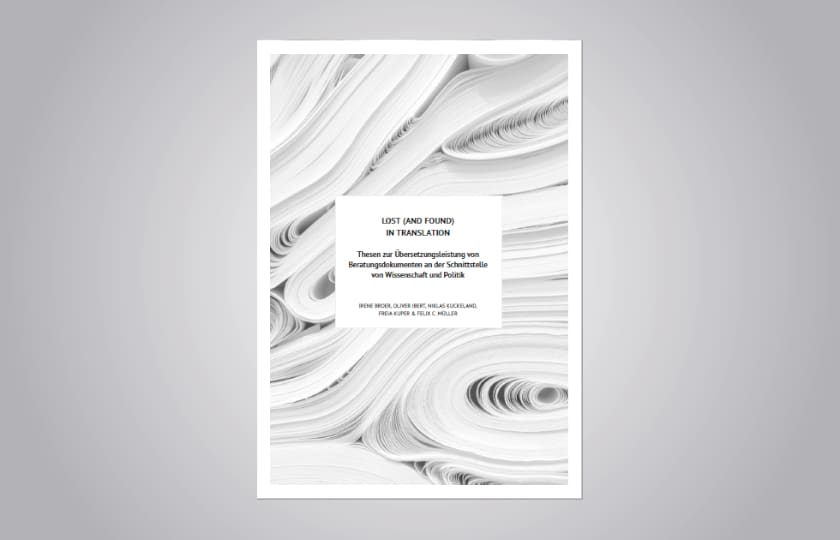
Publikationscover Übersetzung von politischen Beratungsdokumenten
Enabling Political Consulting

Theses on the Translation Performance of Advisory Documents at the Interface of Science and Policy

The thesis paper provides practical tips on how scientific consultation documents should be created and used.

1 … 18 19 20 21 22 … 43

Page 20 from 43

Newsletter

Information about current projects, events and publications of the institute.

Subscribe now