
Order Formation

Communication spaces do not emerge on their own. They are shaped—by law, technology, social practices, economic interests, and institutional decisions. The “Order Formation” research group examines how rules emerge in such communication spaces, who is involved in shaping them, and how responsibility, power, and legitimacy are distributed.

The starting point is the observation that communication today takes place within complex ecosystems. Platforms set rules for content and behavior. Governments establish legal frameworks. Users develop their own practices. Companies design technical infrastructures. Civil society, academia, and the media play a role in monitoring, critiquing, and shaping these spaces.

The research group asks how order emerges from this interplay—and how this order can be aligned with democratic values, fundamental rights, and the common good.

In doing so, it combines three perspectives.

  • First, it focuses on structures: What legal, technical, and social frameworks shape communication spaces?
  • Second, it focuses on processes: How do rules emerge, how are they enforced, and how do they change?
  • Third, it concerns actors: Who makes decisions, who is affected, who bears responsibility, and who holds power?

These questions are examined at the national, European, and global levels. A key focus is on European platform regulation, particularly the Digital Services Act and the Digital Markets Act.

Photo by Sasun Bughdaryan/Unsplash

Overview

Leaders

Last update: 24.09.2026

Blog Articles, News, Projects, Publications, Podcast Episodes

Spielfiguren und Playmobil-Gegenstände auf einem Haufen: Radio, Laptop, Fernseher, Kamera, Buch und Zeitung.
International Cooperation

Transnational Media Histories

Relationships between media and by media do not stop at borders. The cooperative project with the Macquarie University in Sydney investigates such transnational histories of media.

Drei Menschen stehen an einen Maschendrahtzaun gelehnt. Einer blickt ins Smartphone
Subproject Research Institute Social Cohesion

Media Use and Social Cohesion

How do people in different social situations use different kind of media? And how do they contribute to the creation of public spheres and social cohesion?

Junger Mann im Café mit Laptop und Smartphone
Subproject Research Institute for Social Cohesion

Transfer Office “Media and Social Cohesion”

The transfer office “Media and Social Cohesion” is coordinating all transfer and research acitivities of the projects, which the HBI contributes to the Research Institute Social Cohesion.

Junge Frau mit Kopfhörern schaut ins Smartphone.
Study for Hamburg Senate and dpa

Use the News

In the "Use the News" project, the Leibniz Institute for Media Research is researching the news literacy of the population under the age of 30.

Nahaufnahme eines Netzes
Rules in Digital Communication Spaces

Norms of the Net

The framework project bundles research activities in the area of the structural perspective investigation of rule formation in digital communication spaces.

Illustration einer jungen Frau mit Laptop vor einer Deutschlandkarte mit Medienlogos
Study Findings in Video

People Who Use Media Also Trust Them – But Not Unconditionally

In Germany, trust in established news sources can best be explained by age: Older internet users tend to place more trust in the news than younger ones. There are also differences regarding political orientation.

Cover
Open Access!

Longitudinal Upstream and Downstream Effects of Political Participation

Judith Möller and fellow researchers have published an article in the international political science journal "Acta Politica". It examines the question of whether low-threshold political activities make people participate more in democratic processes such as elections or less.

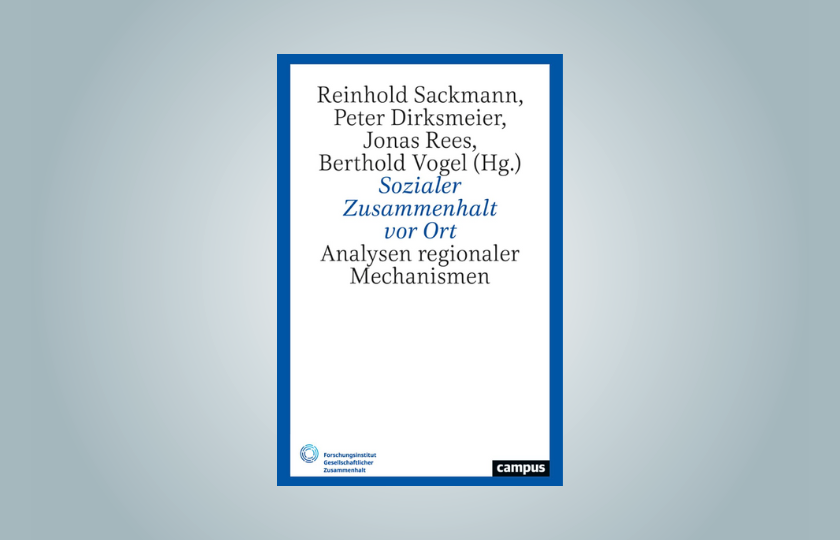
Cover of the publication "Sozialer Zusammenhalt vor Ort"
RISC Publication

Social Cohesion at the Local Level

A new volume in the series published by the Research Institute Social Cohesion (RISC) brings together contributions on the topic of “Social Cohesion at the Local Level.” Among the contributions is an article by PD Dr. Jan-Hindrik Schmidt and Hannah Immler, RISC researchers at the Hamburg section of the HBI, on "Local Media Repertoires and Cohesion-Related Attitudes."

Paper stack
Scientific Accompanying Research

Repository for Policy Documents

Our institute provided scientific support for the development of this specific information and consulting infrastructure.

post_dummy_retangle_2
post_dummy_retangle
1 … 23 24 25 26 27 … 43

Page 25 from 43

Newsletter

Information about current projects, events and publications of the institute.

Subscribe now