Order Formation

Communication spaces do not emerge on their own. They are shaped—by law, technology, social practices, economic interests, and institutional decisions. The “Order Formation” research group examines how rules emerge in such communication spaces, who is involved in shaping them, and how responsibility, power, and legitimacy are distributed.

The starting point is the observation that communication today takes place within complex ecosystems. Platforms set rules for content and behavior. Governments establish legal frameworks. Users develop their own practices. Companies design technical infrastructures. Civil society, academia, and the media play a role in monitoring, critiquing, and shaping these spaces.

The research group asks how order emerges from this interplay—and how this order can be aligned with democratic values, fundamental rights, and the common good.

In doing so, it combines three perspectives.

  • First, it focuses on structures: What legal, technical, and social frameworks shape communication spaces?
  • Second, it focuses on processes: How do rules emerge, how are they enforced, and how do they change?
  • Third, it concerns actors: Who makes decisions, who is affected, who bears responsibility, and who holds power?

These questions are examined at the national, European, and global levels. A key focus is on European platform regulation, particularly the Digital Services Act and the Digital Markets Act.

Photo by Sasun Bughdaryan/Unsplash

Overview

Leaders

Last update: 24.09.2026

Blog Articles, News, Projects, Publications, Podcast Episodes

Screenshot aus der Sendung ZDF heute vom 4.9.2026. Im Bild: Moderatorin Alica Jung (links) und Matthias Kettemann (rechts im Bildschirm).
Tricky Accessories

Should Smart Glasses Be Banned?

Smart glasses, which are data glasses equipped with a camera, AI, and an internet connection, raise new questions about the protection of personal rights. However, according to Matthias Kettemann, new bans are not necessarily needed. Rather, existing laws must be enforced more consistently. He explaines this on the ZDF heute program.

Situation im Workshop: an einem langen Konferenztisch arbeitet eine Gruppe Forschender konzentriert an ihren Laptops
International Workshop at the HBI

Visitors from Brisbane!

Last week, eleven researchers from Australia and Germany worked intensively together at the HBI on the “Mapping Polarization in News Media Content” project, which compares climate reporting in both countries. Among other things, they conducted further analyses and prepared conference papers and publications.

Tobias Mast
Expert Opinion for the SMC

Stricter EU Rules for ChatGPT

The European Commission has classified ChatGPT as a very large online search engine under the Digital Services Act (DSA). Tobias Mast considers this classification reasonable. In his statement for the Science Media Center, he points out that the consequences depend on how the DSA’s requirements, which were originally developed for different types of services, are applied to AI chatbots.

Svea Eckert mit Kopfhörern schaut nachdenklich in die Kamera, hinter ihr sind Arbeits-Laptop und Bildschirm mit Text zu sehen
Podcast Episode

Artificial Intelligence Everywhere Now?

On the Deutschlandfunk podcast, which translates to "After the Editorial Deadline," Svea Eckert discusses why artificial intelligence is suddenly a hot topic everywhere and the logic behind the media coverage.

Portrait von Prof. Dr. Matthias Kettemann
Expert Opinion for the SMC

Record Fine and New Social Media Guidelines for Meta

After 29 U.S. states filed a lawsuit against the media conglomerate Meta, the Science Media Center asked Matthias C. Kettemann to evaluate whether the changes made by the platforms are sufficient to ensure they are no longer harmful. Kettemann was also asked to discuss potential difficulties with age verification and the implications of this lawsuit for future legal actions.

Eine Junge Frau liegt, die Beine hoch an einer Klinkerwand, und schaut auf Ihr Handy
Joint DFG Project with the Weizenbaum Institute

Research on the Impact of Disinformation on Democratic Participation Among Young People

Hamburg, 27 August 2026. How do digital media influence young people’s trust in information and their democratic participation? This is the focus of the DFG-funded research project “SETA – Safeguarding Epistemic Trust in Adolescents: Conceptual Approaches and Policy Options.” The project is part of the DFG Priority Programme "Rethinking Disinformation (Re:Dis)."

Zwei Jugendliche, zu sehen von hinten oben, sitzen auf einer Mauer und blicken auf ein Handy
New DFG Research Project

Safeguarding Epistemic Trust in Adolescents: Conceptual Approaches and Policy Options

The interdisciplinary DFG project, “SETA: Protecting the Epistemic Trust of Adolescents: Conceptual Approaches and Policy Options,” conducted in collaboration with the Weizenbaum Institute, examines the state’s obligation to protect the epistemic trust of 13- to 17-year-olds without infringing on freedom of expression and information.

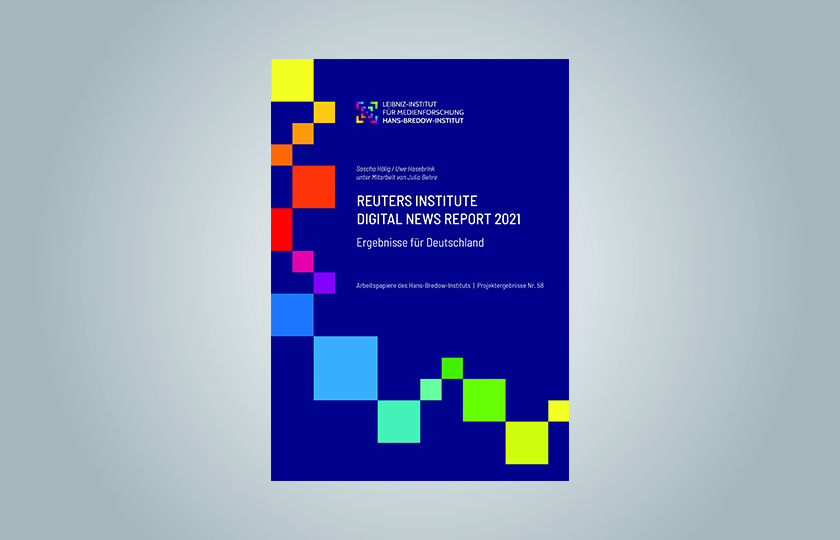
Cover des Arbeitspapiers Reuters-Bericht 2021
Report for Download

Reuters Institute Digital News Report 2021

The Reuters Institute Digital News Report, which provides an international comparison of news consumption, is being published for the tenth consecutive year.

Ein Mensch stützt seinen Kopf an einem Tisch auf seinen Laptop für eine Pause.
Interview on NDR Info

News Fatigue—What Happens in the Brain?

An increasing number of people are avoiding the news, at least occasionally. In an NDR Info interview about news fatigue, Julia Behre explains why this is happening and how newsrooms can address the issue. The segment was part of the program "Wissen" [Knowledge].

Cover der Zeitschrift der Leibniz Gemeinschaft - Ausgabe 2/2026 zum Thema "Medizin"
Click Consultation

Consultation with Dr. Insta

The latest issue of the Leibniz Association’s magazine, which is part of the Science Year 2026, focuses on the topic of “Medicine.” Claudia Lampert, head of the Health Communication research group at the HBI, is interviewed about health influencers.

Blätter und bunte Zettel mit den Ergebnissen der Arbeiten von Gruppe 4, Gruppe 2 usw.
Article on the Media Research Blog

How Politically Empowered Do Young People Feel?

In a current project by Leonie Alatassi, students explore what political participation means to them, how it can be encouraged, and what barriers stand in the way. The first workshops show that many young people are eager to get involved. However, they need not only information, but also concrete support and opportunities to try things out and gain experience.

Bild aus der Research Clinic: eine Gruppe Menschen sitzt im Kreis und diskutiert
Report from the Research Clinic

Hype vs. Doom – How Can AI Reporting Become More Nuanced?

Public debates about AI often oscillate between technological utopianism and dystopian visions of the future. How can journalists report on a topic that is both ubiquitous and difficult to grasp in a nuanced and balanced way? A Research Clinic at the HBI explored the challenges of reporting on AI and discussed possible ways to address them.

1 2 3 4 5 … 44

Page 3 from 44

Newsletter

Information about current projects, events and publications of the institute.

Subscribe now