
“Flood the Zone with Shit” – Elon Musk, the AfD and the Agenda-Setting of the Radical Right in the 2025 German Federal Election

In the current German parliamentary election campaign, the AfD and its top candidate Alice Weidel repeatedly manage to generate a high level of media visibility. This is also decisively linked to the prominent support of US billionaire Elon Musk. The following article explains how Musk’s communicative interventions increase the media presence of Weidel and the AfD and how these dynamics are driven by mechanisms of the digital attention economy.

The article was first published in German on the blog of the Research Institute Social Cohesion (RISC).

Musk Sets the Tone for Public AfD Coverage

“Only the AfD can save Germany,” the American billionaire and advisor to the new Trump administration, Elon Musk, wrote on his short message service “X” in December 2020, in the middle of the German election campaign. Musk had recently attracted attention with radical conspiracy theories, disinformation, insults and, increasingly, communicative interventions in domestic political events in European countries such as Great Britain and Germany. At the end of December, Musk published a guest article in the German newspaper “WELT” [World], followed in January by a live conversation with AfD leader Alice Weidel, which has since been watched by millions of users. The conversation between Weidel and Musk included not only AfD campaign ads, but also numerous half-truths, misinformation and historical revisionist statements (Weidel: “Hitler was a communist”). Celebrity support in the campaign paid off for the frontrunner, for example on platform X, where Weidel’s prominence skyrocketed in time with Musk’s digital interventions (Nenno & Lorenz-Spreen, 2025).

Weidel, Musk and the AfD: X as a Springboard into the Traditional Media Landscape

Similar effects can be observed in the broader German media landscape. The mere announcement of the conversation between Musk and Weidel on X dominated the headlines of major German media outlets:
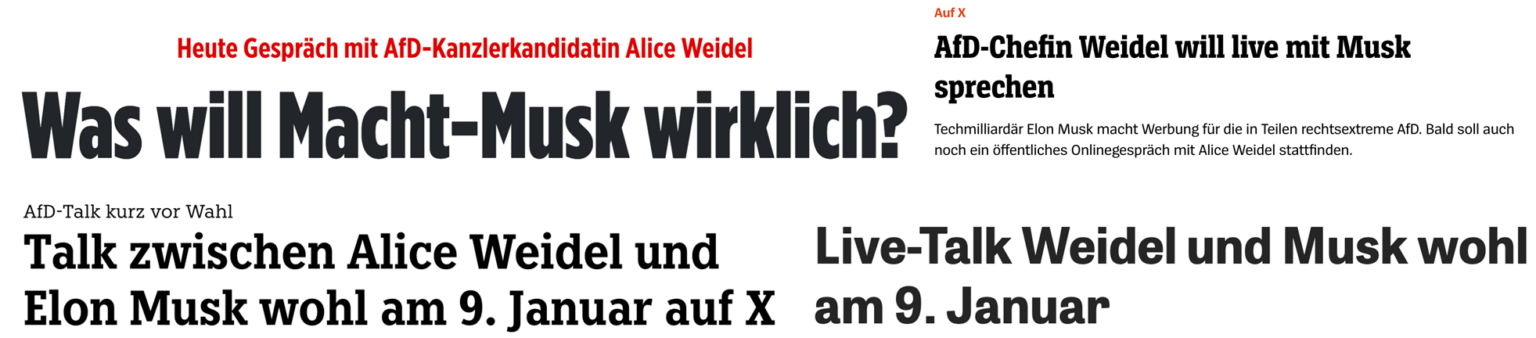
Online-Berichterstattungen in traditionellen Medien: Titelseiten von BILD, SPIEGEL, taz und DIE ZEIT
Online coverage in traditional media: Front pages of BILD, SPIEGEL, taz and DIE ZEIT

A brief quantitative analysis of German-language online media articles using the Media Cloud analysis tool (see methodological notes at the end) confirms that Musk’s interventions contributed to a significant boost in visibility for AfD top candidate Weidel. The share of media articles containing the terms “Weidel” and “Musk” (dark blue) in relation to articles that only mentioned the term “Weidel” (light blue) increased significantly around the election call (December 20: 37%), the WELT article (December 28: 55%) and the X-Talk (January 9: 91%).
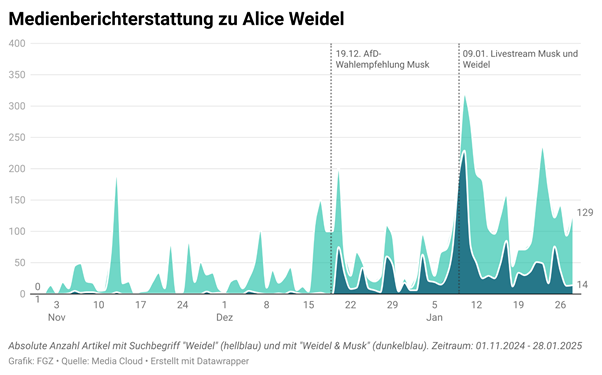
Statistics: Media Coverage of Alice Weidel

The connection became most obvious in the week around the X-talk of Weidel and Musk. On January 9, MediaCloud recorded the highest number of articles with the term Weidel (205 articles) to date, of which 186 also mentioned Musk. Over the week from January 6 to January 12, the number of articles mentioning Weidel skyrocketed to a record 1,243 articles.
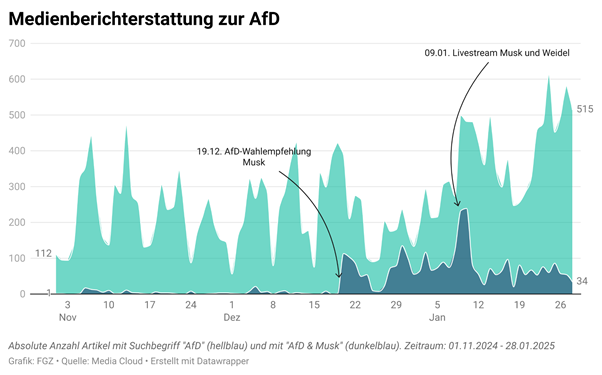
Statistics: Media Coverage of the AfD

If we use the search term “AfD” instead of “Weidel”, it becomes clear that the knock-on effects so far seem to have had a stronger impact on the person and less on the party as a whole, although more moderate effects around the key events are also visible there.

The Digital Attention Economy as the Basis for the Hyper-Salient Communication of the Far Right

The rise of the radical right’s media visibility is based on dynamics that exemplify the transformation of discursive power structures in the digital public sphere. Digital media open up a communicative space of opportunity for actors beyond the traditional political map (such as Musk, AfD, Weidel), in which they can both communicate directly with their supporters without going through the media (inward-looking communication) and substantially influence public discourse (outward-looking communication). The latter is an expression of the current hybrid media system, in which digital and traditional media combine and influence each other. The digital attention economy is particularly fundamental to these mechanisms. Here, political and media actors as well as digital platforms compete for the attention of media consumers in order to communicate their messages and generate advertising revenue. Since the amount of available information in the context of digital media has increased dramatically, but the available human attention has remained the same, competitiveness in the digital attention economy has increased significantly. Even more than before, communicative strategies that make it possible to assert oneself in this environment are becoming increasingly important.

Provocation as a Strategic Tool for Agenda Setting and Hacking

The radical right seems to be more aware of the logic of the digital attention economy than other actors and uses it strategically. For example, Elon Musk’s prominent support of the AfD in the German federal election campaign was a particularly successful form of agenda-setting that significantly increased the media visibility of Weidel and the AfD. Weidel’s historically revisionist statement about Hitler and National Socialism was probably based, among other things, on a strategic interest in further shifting the “boundaries of what can be said” and normalizing extreme right-wing narratives. However, the statement also seems to have been placed as a deliberate provocation, which Weidel could be sure would attract the appropriate media attention and increase her own visibility in the limited attention span of the public arena.

US President Donald Trump has already used the principle of attracting attention through targeted and strategically placed provocations with great success in recent years. Even during the Republican primaries in the run-up to the 2016 presidential election, Donald Trump was able to attract a disproportionate amount of media attention by breaking norms and taboos. This helped him win both the primaries and the presidential election (Schroeder 2018, Wells et al. 2016). Steve Bannon, Trump’s former campaign manager and co-founder of the right-wing extremist portal Breitbart, described the principle of the communicative strategy of the first Trump administration as follows: “Flood the zone with shit”. In this reading, the only decisive factor for evaluating the success of this strategy is media visibility. The truthfulness of one’s own statements and the question of whether public coverage of the statements is more positive or more negative do not play a significant role. This is because the positive reception of statements is ultimately ensured by the (digital) communication channels of the supporting political camp, whose reach is constantly expanded by the strategy described.

Radical Right-Wing (Digital) Noise Pollution: DDoS Attacks on Our Minds

The key to this strategy is to deny the political opposition the opportunity to make an appearance or set its own agenda. Instead, they work on the issues and narratives set by the radical right, as do the media and the press, and rarely set issues of their own. US journalist Julia Angwin describes this strategy of agenda-setting through constant taboo-breaking and provocation as a “DDoS attack on our minds“. DDoS attacks (distributed denial-of-service attacks) are actually a cybersecurity term that describes the overwhelming of a web service (e.g. a website) by a flood of (fake) requests. Applied to the AfD’s strategy and the powerful support of Elon Musk, this form of agenda-setting can be described as a systematic overloading of the political will-forming process. The discourse and information practices on which the formation of political will is based are undermined by constant, often empty and provocative provocations. The functionality of the political decision-making process itself seems fundamentally endangered in the long term.

Debate on How to Deal with the Discourse Strategies of the Radical Right

At this point, it is difficult to say what specific impact the described gains in public discourse will have on the outcome of the 2025 federal elections. The findings of this brief analysis illustrate how quickly public discourse can be hijacked by social media in the slipstream of global political events. And they show how fluid the boundaries between radical digital fringe communities and traditional public discourse spaces can sometimes be.

There is certainly room for political and media action to address these developments. The European Digital Services Act (DSA), like the AI Act adopted in the EU in August 2024, offers a broad scope for intervening. In particular, the broad concept of systematic risks for social debate, electoral processes and public security (Art. 34, 35 DSA) offers leverage points for action against the described dynamics of a digital attention economy. The German Bundestag administration and the EU have announced reviews due to the live talk between Musk and Weidel. DSA proceedings have been underway for some time against some major platform operators. With regard to the public debates in the election campaign, a significant part of the decision-making authority over the nature of the coverage lies with the private media houses and public broadcasters, even though the hybrid media system and the digital attention economy are creating considerable centrifugal forces here. Diverse, comprehensive and informed coverage of the AfD seems necessary, especially in the context of a polarized election campaign. However, a permanent media presence can also have undesirable side effects that benefit the discourse strategies of the far right more than they harm them. In view of the political and media gains of the globalized radical right, there is a need for an ongoing debate in society as a whole about the occasions, extent and form in which the digital barrage of the radical right should be given space.

Methodological Notes

MediaCloud is an open-source analytics platform for online media coverage. The platform collects online media articles provided by the RSS feeds of media websites. Our analysis is based on a collection of 257 media websites from Germany, whose coverage in the period from November 1, 2024 to January 28, 2025 was filtered using the keywords listed above. Not all articles that were indexed by the keywords and included in the graphics above have Musk, Weidel or the AfD as their main topic. However, a random manual validation confirms that the articles essentially cover the media coverage of the aforementioned actors.

Literature

Franck, G. (1998). Ökonomie der Aufmerksamkeit: Ein Entwurf [Economy of Attention: A Draft] (12th edition). Edition Akzente. Carl Hanser Verlag.

Nenno, S. & Lorenz-Spreen, P. (2025). Do Alice Weidel and the AfD benefit from Musk’s attention on X? Alexander von Humboldt Institute for Internet and Society. https://www.hiig.de/en/musk-x-and-the-afd/ https://doi.org/10.5281/ZENODO.14749544

Schroeder, R. (2018). Social Theory after the Internet: Media, Technology, and Globalization. UCL Press. https://doi.org/10.2307/j.ctt20krxdr

Wells, C., Shah, D. V., Pevehouse, J. C., Yang, J., Pelled, A., Boehm, F., Lukito, J., Ghosh, S., & Schmidt, J. L. (2016). How Trump Drove Coverage to the Nomination: Hybrid Media Campaigning. Political Communication, 33(4), 669–676. https://doi.org/10.1080/10584609.2016.1224416

Cover image: iStock, Credit: da-kuk

Connect or divide? What the media (should) do

This is it …

EN-Test: The Magic of the Rainbow – an explaining of a natural phenomenon

The Formation of a Rainbow

A rainbow is one of the most fascinating phenomena in nature. It occurs when sunlight hits raindrops and is refracted, reflected, and refracted again. This interaction causes the light to split into its constituent colors, forming a vibrant arc in the sky. The basic colors of the rainbow are red, orange, yellow, green, blue, indigo, and violet.

The angle at which light is refracted is about 42 degrees from its original direction. Therefore, a rainbow is seen when the sun is behind the observer and rain clouds are on the horizon. The perfect combination of light and water droplets creates this impressive spectacle.

Significance and Symbolism of the Rainbow

A rainbow arches over a pony standing on a green meadow. The scene is vibrant with lush grass, a clear blue sky, and the colorful spectrum of the rainbow prominently visible above the pony. A rainbow holds not only scientific significance but also rich symbolism. In many cultures and myths, the rainbow represents hope, peace, and a connection between heaven and earth. In modern times, the rainbow has gained strong symbolic importance as a sign of diversity and acceptance. The LGBTQ+ community has adopted the rainbow as a symbol for their movement to celebrate and protect the diversity and rights of all individuals.

Interesting Facts About Rainbows

  • A rainbow is always a circle, but from the ground, only part of it is usually visible.
  • Double rainbows occur when light is reflected twice inside the raindrops. The second arc is fainter and has reversed colors.
  • Rainbows can also appear at night and are called moonbows. These are often fainter and less colorful.
  • Sometimes, rainbows can be seen in waterfalls or the mist of the ocean.

Clearing the data fog: german far-right research’s requirements for the DSA research data access (EN)

​„Barbie”-Filmanalyse: Alles so schön pink hier?

Medienwissenschaftlerin JOAN BLEICHER über Greta Gerwigs neuen Film „Barbie“ und dessen Rezeption.

Greta Gerwigs neuer Hitfilm „Barbie“ ist ein Genrehybrid aus vielfältigen Bausteinen des populären Kinos. Er ist Roadmovie, Slapstick-Komödie, Animationsfilm, Krimi, Surf-Film, Science Fiction, Familienfilm, Musik- und Bollywood-Tanzfilm in einem. Außerdem wird er als feministische Gesellschaftskritik rezipiert. Durch die ironische Übertreibung von Männlichkeits- und Weiblichkeitsklischees veranschaulicht er den Geschlechterkampf. Barbie steht als Symbol exemplarisch für die Konsumorientierung weiblicher Geschlechterrollen, die die Identitätskonstruktion und Wahrnehmung eigener Interessen verhindert.

Der Film ist zudem eine große PR-Kampagne für Barbie-Hersteller Mattel. Das Warenspektrum rund um die berühmte Spielzeugpuppe wird optisch attraktiv und somit werbewirksam in Szene gesetzt. Interessant ist jedoch, dass zwar sehr viele Merchandising-Artikel verkauft werden, die Puppe selbst jedoch noch keine nennenswerte Absatzsteigerung aufweisen kann.

Alles schön und gut in Barbieland…

Der Film beginnt in einer virtuellen Barbie-Welt, die nur aus Schönheit und Unterhaltung besteht. Inszenierungen von erfolgreichen Frauen (Präsidenten-Barbie, Nobelpreis-Barbie) ersetzen tatsächliche berufliche Aktivitäten und Machtpositionen. Plastik (Körper, Häuser, Natur), Pink und Rosa bilden die visuellen Oberflächen der Künstlichkeit von Barbies Scheinwelt, die sich mit dem Ziel des Selbsterhalts der kapitalistischen Utopie nicht mit der Realität mischen darf.

Barbie bricht jedoch aus ihrer Plastikwelt aus und begibt sich in die Realität. Dort erfährt sie eine „existenzielle Erschütterung“, wie Marie-Luise Goldmann es in ihrem Beitrag in der WELT beschreibt: „Als sie in der echten Welt einen Schulhof betritt, bleibt die erwartete Begeisterung vonseiten der Kinder aus. Stattdessen werfen sie ihr an den Kopf, sie zu hassen und schon seit dem Alter von fünf Jahren nicht mehr mit ihr, einer Faschistin und Kapitalistin, die am ungesunden Körperbild so vieler Frauen schuld sei, zu spielen.“ Implizit wird die narrationstheoretische Frage nach dem Verhältnis von Fiktion und Realität und nach den Erlebnisdimensionen filmischer Bedeutungskonstruktion gestellt.

Feminismus des Barbie-Films

Barbies Kontakt mit der Realität führt zur Anpassung der bislang weiblich dominierten Geschlechterhierarchie der Barbie-Welt. Dies bildet den Ausgangspunkt für die ironische Darstellung von Männerrollen in Handlung (Selbstinszenierung, Wettkämpfe, Gewalt), Sprache und Requisiten (Autos, Sportartikel, Kleidung, Wohnungseinrichtung). Als Barbie mit Ken die echte Welt betritt, dauert es einige Zeit, bis den beiden dämmert, dass hier etwas nicht stimmt: Hier regieren Männer! Ken kann sein Glück kaum fassen. Er könnte hier alles sein: Arzt, Bademeister, sogar Präsident, nicht nur Ken, nicht nur einer, der erst in Verbindung mit Barbie eine Identität erhält. Goldmanns Fazit: „Barbie ist nicht nur ein feministischer Film geworden, sondern ein Film über den Feminismus. Er denkt den Feminismus nicht nur mit, sondern er denkt ihn neu.“

Auch Dietmar Dath unterstreicht in der FAZ den dem Film eingewobenen Feminismus. Ein wichtiger Monolog im Film enthalte etwa viele implizite, „sehr vernünftige feministische Minimalanforderungen“ und sei deshalb geradezu das „große Herz des Films“. Kritiker Matthias Schwardt hingegen bemängelt in der TAZ ebendiesen „Grundschulfeminismus“ und die „schmierigen Hollywood-Klischees“ à la „Ich bin was wert, du bist was wert, alle sind was wert! Feiern wir das Leben der unbegrenzten Möglichkeiten!“

Barbie kombiniert Unternehmens-PR mit kritischer Botschaft

Regisseurin Greta Gerwig setzte sich bereits in einer Reihe von Filmen wie „Lady Bird“ kritisch mit Frauenrollen und Genderklischees auseinander. Mattel wiederum nutzt den Film trotz seiner kritischen Dimensionen als Unternehmens-PR und plant eine Reihe weiterer Verfilmungen der eigenen Spielwarenproduktion, wie beispielsweise Polly. Mathias Schwardt beschreibt die PR-Strategie wie folgt: „Die Traditionsbarbie – blöd, aber hübsch und mit zimmergroßem Kleiderschrank gesegnet – ist die Inkarnation des Frauenverständnisses von Steinzeitmachos. Gerwig verschafft dem Unternehmen nun Credibility. Was, so die Hoffnung, auch die Puppen und den anderen Plastik-Krimskrams plötzlich hip macht.“ Ob diese Strategie tatsächlich durch die geplante Filmreihe realisiert werden kann, bleibt fraglich.

Doch veranschaulicht der Film aus meiner Sicht die Möglichkeiten, bunte Oberfläche, stereotype Rollenklischees und eine humorvolle Selbstironie mit widersprüchlichen Funktionen der Unternehmens-PR und einer kritischen Botschaft zu kombinieren.

Der große Publikumserfolg des Films basiert auf einer langfristigen PR-Strategie. Fotos der Schauspieler*innen statt Informationen über den Filminhalt weckten zunächst ebenso die Neugier wie die Regisseurin Greta Gerwig, deren bisherige Filme so gar nicht zu dem Barbie Image passten. Auch erste Trailer verbargen mehr als sie zeigten. Vielfältige Genrebausteine, implizite Theorien, populäre Erzählmuster, viel Selbstironie garniert mit Pink und Musikstücken bildeten schließlich das attraktive Endprodukt.
Foto: Myke Simon / unsplash

Can Platforms Cancel Politicians?

An international study led by the HBI provides a first comparative overview of how societies and governments in 15 countries react to private power over political actors.

by Martin Fertmann, Matthias C. Kettemann and Mara Barthelmes

Private power over public speech is often contested, but the conflicts are magnified when this power is asserted over parties, political candidates and office holders who are focal points of public debates. Although most platform terms of use and their enforcement systems are global, opinions differ on the possible preferential treatment of speech by prominent politicians and office holders according to national political and legal contexts.

In a recently published study, we examined the interplay between these national rules and global private ordering systems by synthesizing answers to nine questions submitted by more than 30 researchers from 15 countries within the GDHR Network. Our studies provides a first empirical and comparative overview of how societies and governments conceive of and react to private power over political actors.

From January 6, 2021, onwards, Internet platforms like Twitter, Facebook and Instagram, YouTube, Twitch and Snapchat suspended the accounts and channels of Donald Trump and his supporters. But not only the platforms as top layer of the Internet reacted, financial service providers, App stores and even email service providers and dating apps took similar action. The response to Trump’s suspension as the first and most discussed action by platform companies against an (albeit: exiting) head of state from the global North provided an insight into the state of debates on platform governance in the participating countries.

This “deplatforming” has shown one important point very clearly: platforms can intervene (and remove content and users) very effectively if they want to. Even during the U.S. election campaign, they limited algorithmic recommendations, banned political ads, demonetized and deamplified problematic content. The platforms (re)discovered that the fight against hate speech and disinformation, especially in the context of the fight against Corona, also appeals to politicians and customers.

Private vs. state regulation

The study revealed that in the ongoing debate about who should set and enforce the rules for speech on online platforms, terms of service-based measures against political and state actors – as both key subjects and objects of political opinion formation – have become a focal point. State regulation of platforms creating an obligation to spread information is regarded, with minor national differences, as dangerous for the free and unhindered discursive opinion-forming process.

Similarly, the exercise of content moderation policies by the major platform companies is seen critically by politicians in all countries examined. Most politicians in European countries emphasise fundamental rights and demand that such decisions should be made by states, not by private companies. Such positioning, however, is in unresolved conflict with the constitutional realities of the participating countries, according to which office holders mostly cannot invoke fundamental rights when acting in their official capacity and where laws with “must-carry” requirements for official information do not exist for social media and would probably only be constitutional for narrowly defined, special circumstances such as disaster prevention.

The increase in power of platforms over societal discourses that is accompanied by them restricting democratically elected office holders or setting the terms under which political campaigns can take place challenges our understanding of who should set standards for political speech. Conversely, state interference in the way official information is or is not spread by private actors is not just met with scepticism but is also under significant constitutional constraints in many countries.

Creating new hybrid actors

The referral of the Trump decision to Facebook’s Oversight Board has launched a broader debate on institutional structures to improve content governance by creating hybrid actors such as independent “Social Media Councils”. Such institutions would not be constructed entirely from the perspective of either companies or states but would incorporate elements of external societal input with a degree of independence from both states and companies.

Media commentators in participating countries interpreted the deplatforming against Trump as a signal that far-right parties and politicians around the world may face increasing scrutiny. Meanwhile, conservative politicians and governments in several participating countries instrumentalized the actions against Trump as alleged evidence of the platform’s bias against conservative opinions. Although in most cases there are no specific legal requirements for content moderation, contributions from several countries point to a general – often constitutional – privileging of the expression of politicians and office holders. This could potentially support or even force platforms’ decision to allow content from political actors, even if it violates their terms of use.

The discussion about the influence of social media on public discourse is still in its infancy. While the de-platforming of Donald Trump may not have been the origin of this debate, it has definitely added fuel to it.

Photo: Micha Matlon / unsplash

Twitter, Trump and The Taliban – The Need for Better Rules for Online Speech Governance

How come the Taliban have access to social media while former President Trump does not? The short answer is that Trump has deliberately violated the internal speech rules of social media companies before being banned while certain Taliban and Taliban-affiliated accounts have not done so recently or consistently. They are, however, often banned and/or suspended. But things are complicated.

by Martin Fertmann, Matthias C. Kettemann, David Morar and Wolfgang Schulz

Social media companies have emerged as important normative actors. Their decisions have global implications. They are, more unwillingly than not, in the middle of some of the world’s key political conflicts. Especially in situations of political instability, the power of defining communication rules matters. Whether in Syria, in Kenya, Uganda, in India or most recently in Myanmar: the decisions that social media companies take reverberate around the globe.

Platforms therefore have to carefully assess how to engage with violent and powerful actors, especially if they – as the Taliban now – exercise state powers. This is one of the reasons why social media platforms had a hard time dealing with Trump – and kept the former US President online long after he had thoroughly violated platform rules.

As we have shown in a recent study, the exercise of private power over public speech is often contested, but the conflicts are magnified when this power is asserted over parties, political candidates and office-holders that function as focal points for public debates. While most platforms’ terms of use and enforcement systems are global, opinions relating to any preferential treatment of speech by well-known political figures and office holders vary across national, political and legal contexts.

Banning the Taliban?

Can Twitter ban the Taliban? Yes, it can. While Twitter is certainly an important global communication platform, it is under no specific duty to provide access to media to any government, much less to a non internationally-recognized military dictatorship. But when it bans the Taliban (or anyone else, for that matter), Twitter has to apply its rules fairly to its users. Applying rules equally, without unfair distinction, is a staple of most national legal orders. While private companies enjoy substantial freedom in deciding which contracts to enter into (under what conditions and with whom), this freedom is more limited when these platforms provide a service that approaches non-substitutability, that is when they exercise substantial power over the communication spaces they have constructed. As we have argued elsewhere, the private orders of companies are part of, and intrinsically linked to, the communicative space they provide. In designing this space, and setting rules, their freedom to choose the rules and enforcement tools they like gets increasingly smaller. This is at the heart of demands for more transparency and accountability. At least in Germany, the Supreme Court (BGH) has recently ruled that before an account is banned, the concerned user has to have an opportunity to defend themselves. (For deleted postings, the BGH demanded a limited ex post review).

To the case at hand: Was Twitter wrong in banning Trump but not the Taliban? Let’s check the facts:

  • Trump has broken Twitter’s rules many times, but has gotten a pass almost every time, in his role as first a candidate and then the President of the United States.
  • The Taliban as a whole are an amorphous group of people, a loose political group, which could mean a general ban would overly restrict harmless pieces of content. Facebook and other platforms have had problems in the past addressing amorphous groupings, like QAnon. The Taliban’s specific members are subject to individual account rules and, in the eyes of Twitter, not all of them have run afoul of them on the platform. (A Whatsapp group created by Taliban, however, seems to have been banned.) A number of media-oriented websites also went offline though it was not immediately clear which service provider – and at what level of the “stack” of delivering internet content – was responsible.
  • The Taliban and its officers are not officially designated by the United States, where Twitter operates from, as a foreign terrorist organization (like the Pakistan Taliban or al-Qa’ida are), but sanctioned as a Specially Designated Terrorist Group. This means that their US assets are frozen and Americans are prohibited from working with them, but only under 31 CFR § 595.204. To those outside of foreign policy circles the difference may seem like semantics, but it makes a significant difference for platforms. The penalties here are much softer (see 31 CFR § 595.701 et seq.) than for providing services to “foreign terrorist organizations”, which is a criminal offence for which responsible persons can be punished with up to 20 years in prison (or life, if the death of a person results) (18 U.S. Code § 2339B). Although it is dubious whether the provision of a free and freely available online service would actually suffice as “material support” under this provision, the fear of this has motivated companies such as Zoom in the past to try and prevent FTOs from using their services.  Meanwhile, other platforms, like Facebook, have taken a more hardline approach and rely not just on the US “terrorist” organizations lists, but on its own designation as “Dangerous Individual or Organization”.
  • Twitter is also playing an interesting game where it does not want to be a de facto validator of the Taliban as the rulers of Afghanistan, so it is simply continuing its previous treatment of the organization, until the United States and the international community decide how to treat them.

Through the possible orientation towards international reactions such as UN resolutions, the Taliban case may increase the role of international law in platform governance in general: in the past, tech companies have often opportunistically supplied different sides of international (e.g. border-) conflicts with nationalized versions of their products, essentially geo-blocking their services into coherence with competing legal obligations or political narratives.

But how can companies deal with conflicts between national power-holders and international law? This question is largely unresolved. For example, Twitter and Google both state that they prevent any content found to be illegal under “local law” (whose law, one may ask relating to Afghanistan)  from being accessed from the respective jurisdiction, while at the same time claiming their policies are rooted in international human rights law (here and here). Their transparency reports show they do not act on all “government” claims, but  they don’t publicly cite international law as a reason, instead claiming to have a different interpretation of the respective national law or practical issues.


Get rid of the bad, don’t touch the good

This wiggle-out strategy will likely not succeed vis-a-vis blatant human rights violations by the Taliban. It seems more likely the difficult spot the companies’ find themselves in will be resolved by explicit references to international law and future United Nations resolutions on the (non)recognition of the self-proclaimed Taliban government. Similarly, companies in the past have found it easier to refer to international human rights to motivate their reluctance to adhere to national decisions.

The world of online content moderation might seem easy: get rid of the bad stuff and don’t touch the good stuff. But reality is never that simple. It is very difficult to choose who actually gets to decide what stays online or goes offline. And after that decision has been made, enforcing it – often via algorithmic tools – is very difficult.

While content moderation at scale is hard, a global conversation on the guidelines that would help platforms make better rules is essential. Where should these meta-rules come from? The Leibniz Institute of Media Research’s Private Ordering Observatory is currently conducting global conversations to find out more about these questions. Some have suggested the creation of more social media councils to help platforms set better rules. These represent a good opportunity to increase the legitimacy of the normative orders of platforms, strengthen the protection of individual rights, and promote social cohesion. Within the EU, proposals to build a platform monitoring entity have also been published. But perhaps better than individual and regional councils or oversight boards, which provide mainly ex post rulings, a global node for exchanges on the most challenging developments in platform policies is necessary. The Private Ordering Observatory will function as such in an inaugural phase.

Call for new ways

What makes the development of good rules for a better online discourse especially difficult is that private and public norm-making is deeply connected – a new hybrid speech governance regime has emerged. While traditionally distinctions between private and public law were important, online speech governance forces us to reconsider this. The status and perspectives of speech governance by internet platforms can be better understood by acknowledging that there is – and increasingly will be – a normative field in which we find a hybrid mixture of private and public norms (and values). This calls for new types of norms, new ways of “doing law” and new institutions. The development challenges the “state action doctrine” in US constitutional law, concepts of horizontal application of fundamental rights and other normative concepts that rest on the distinction of public and private regulation. Based on that shift of perspective, new analytical tools and elements of governance architecture can be designed and evaluated. And that is needed to protect freedom of speech in digital societies.

Looking into the future, we wonder whether perhaps an entity like the European Commission for Democracy through Law (“Venice Commission“) might be an interesting model. Wouldn’t the platform ecosystem profit from an independent consultative body that provides expertise and conducts studies on platform law and its impact on democratic institutions? One key task of any global discussion on meta-rules for platforms will be that we need to strengthen our understanding of the interaction of international law, regional law, national law and non-binding standards and transnational arrangements (“soft law”) that are applied on and to the Internet; and the relationship between politics and power; and the role of automated vs. human enforcement.

Finally, one would hope that former President Trump recognizes that the argument, that he needs his social media profiles back because he is less of a threat to human rights and global democratic discourse than the Taliban, is not quite as strong as he might feel.

Photo: Jon Tyson / unsplash

Making Courts Count in Global Content Governance

Technology creates societal fractures. Courts have traditionally been responsible to apply the law to fill fractures, ease normative tensions, develop social mores. But courts are uneasy rulers in times of technological change, even as platforms seek to recreate private quasi-courts. Yet their power – especially when mediated by automated tools – is substantial. In more ways than one courts are the hidden rules of digitality. High time to rediscover their powers.

by Matthias C. Kettemann, Wolfgang Schulz  and Giovanni De Gregorio

Be it international treaty-making, top-down or multistakeholder-based development of new norms: amongst state actors, governments are the most active players on the international Internet governance scene. National and European legislators are also prominently engaged in normative activities with regard to the Internet. Just consider, locally, Germany’s Network Enforcement Law (NetzDG) and, regionally, the proposals for a Digital Services and a Digital Markets Act.

But which institutions are missing? What institution has substantially impacted the EU’s data transfer practices? Which bodies developed balancing exercises between privacy rights and freedom of information for content that someone wishes to disappear from the Internet? Who ruled that certain intermediaries had to delete obviously illegal content without any delay – and even beyond borders, if international allows? Courts, courts and courts.

Largely unnoticed, a growing body of cases has emerged that – read together and analyzed separately – greatly influence the development of norms on the Internet and have substantial impacts on the rights of citizens-consumers. From Delfi v Estonia to Facebook Ireland, from Google Spain to the III.Weg, the role of courts in structuring the public’s use of the Internet and indeed the ‘public’ness of the Internet has been substantial.

Private “Quasi-Courts”

But courts are not alone in normatively structuring the Internet. Online platforms, especially social network services providers, have become their own quasi-courts. A growing number of moderator-judges takes thousands of content-related decisions each day. Helped by artificial intelligence they have become key decision-makers that shape what users are allowed to publish and read.

Faced with substantial critique as to the opacity of this process, at least one major social network provider, Facebook, has prominently installed a dispute settlement mechanism, an Oversight Board for content decisions. This auto-judicial approach has both its merits and its limits. While relying on internal quasi-judicial proceedings, Internet companies have not yet been too enthusiastic in joining other more state-oriented models of regulated self-regulation, as foreseen e.g. in the Network Enforcement Act. But voluntary self-control mechanisms can work, as the example of the procedures instituted by Germany’s multimedia services providers in the context of protection of young people show.

Alternative judicial procedures within Internet companies can be more reactive and reach decisions more quickly. But many questions remain: What about the members, their selection, independence, qualification and time in office? How to ensure necessary consistency with other opinions, cultural sensitivity, commitment to values, transparency? These issues have been discussed with regard to traditional courts for decades; quasi-judicial institutions need to find convincing answers. Especially, as new forms of private Supreme Courts emerge, such as the Facebook Oversight Board whose role – an interpreter of rules? A rule-maker? – remain unsettled.

Hybridisation

This mix of public and private adjudication leads to a hybridisation of the very legal bases on which courts take their decisions. While the power of governments to create norms could be efficient but usually limited for separating powers, traditional legislative procedures are much slower. How do the norms on which judges base their decisions develop? How transnational organisations and businesses contribute to this framework? How can highly trained judges intervene meaningfully in the content moderation activities of social network services providers? And are judges always better than algorithms in discovering, for instance, patterns of discrimination that are premised upon big data analytics?

Before the rise of private adjudication or alternative dispute resolution systems, traditional courts, however, need to be asked similarly challenging questions: how do they situate themselves and their cases vis-à-vis other courts deciding on similar fact patterns? And what about the geographic reach of judgments? Are judgments enforceable across Europe? How do they engage with the possible consequences of their judgments when these might extend to areas outside of their jurisdiction? Is a new rule of comity between judicial systems emerging?

In light of the growing number of cases a new comparative approach seems to make sense. Closer cooperation between national courts and quasi-judicial institutions could also be a solution, just as the increasing use of algorithms in courts and the judicial control of algorithms in use by companies and alternative dispute mechanisms. But we can only draw the necessary conclusions based on case data. The Global Freedom of Expression case collection at Columbia University and the database of the Internet & Jurisdiction Network are important resources, but a more thorough analysis is necessary.

This analysis might also find out which judicial and quasi-judicial institutions are ‘norm entrepreneurs’ in that they seem eager to engage in Internet cases and take on influential Internet companies. These include the French data protection agency CNIL and the data protection agency of Schleswig-Holstein. Studying this judicial avant-garde may help us predict not only the characteristics of this adjudication but also which judicial and quasi-judicial institutions may take the lead in jurisprudence on algorithmic decision-making and artificial intelligence.

We understand courts (and quasi-judicial entities) to be part of a communicative-jurisprudential figuration. We need to further explore their contours and interlinkages. Courts and quasi-courts can be agents of disorder by relying on siloedapproach to deciding cases on the Internet. Their narrow view on the cases would suggest that Courts can just partially impact the evolution of digitality. If left unremedied, these tendencies can crystallize into normative fractures that lead to legal uncertainty for states, companies and citizen-consumers.

But a different (judicial) world is possible. From the prohibition of the sale of Nazi paraphernalia (as in the early Yahoo cases in France) to the delineation of filtering obligations for intermediaries (as in the Delfi, MTE and Pihl cases by the European Court of Human Rights) and from the development of a fundamental right to the guarantee of the confidentiality and integrity of information technology systems (by the German Federal Constitutional Court in 2008) to the “right to be forgotten” (in Google Spain at the CJEU) or more precisely a “European dereferencing right” (in the Advocate General’s opinion in Google/CNIL): courts have shaped the communicative figuration and normative order of the internet in the past. It is now time to take a critical look at the role that courts and quasi-judicial institutions will have on the evolution of the internet, its players and layers, rules and tools, in the future.

We see constellations of actors, including courts and quasi-judicial institutions, to have a special but understudied role in the communicative process of Internet governance. For this reason we will host a workshop series dealing with different angles of judicial power in relation to Internet governance.

Photo: Tingey Injury Law Firm / unsplash

Trump’s social media ban: Reviewing the constitutionality of capital digital punishment

10.03.2021

Trump’s ban from social media, while gaining significant media attention, does not represent an isolated case. Preventing individuals from accessing social media platforms or parts of them is a common phenomenon today. I term it ‘social media exclusion’ and I argue that it is possible to distinguish three types of this phenomenon on the basis of the actors and specific underlying factors determining the users’ exclusion.

In the first case, social media users are excluded by other social media users. In US case law, this typology of social media exclusion has materialised in cases where citizens were prevented from directly interacting on social media with their elected representatives. The most notorious case involved the same former President of the United States, Donald Trump, who blocked a series of individuals on Twitter. US Courts eventually held that Mr Trump had elected to use his own social media space as a source of official news and public debate, and that, as a consequence, individuals could not be barred from accessing such a space of public interaction.

A second type of social media exclusion arises where social media users are prevented from accessing a social media website by the platform itself. In this second category, we can include Donald Trump’s recent ban from social media. So far, these cases have been common in German case law, where some users saw their accounts disabled by Facebook for having posted comments which allegedly infringed the terms of use of the platform, particularly the prohibition of hate speech. German courts upheld the importance of translating a series of basic constitutional principles and, in particular, various articulations of the rule of law and the principle of proportionality in the context of social media online content moderation. According to German judges, the decision of a platform to ban a user should be objectively justified and should not be arbitrary; platforms’ policies on banning users should be based on objective criteria; a user’s ban should not be automatic, and, platforms’ sanctions should be proportionate, taking into account the seriousness of the offence and the previous conduct of the user.

The third and final example of social media exclusion occurs where national law directly prevents specific individuals from accessing (some) social media platforms. This is common in the US, where national laws prevent former sex offenders from accessing social media. The US Supreme Court in Packingham affirmed that the law of North Carolina disproportionately restricted access for these individuals to what today are ‘the most important places for the exchange of views’.

Constitutional Relevance of Social Media and the Role of Courts

Indeed, today social media represent an essential instrument for exercising a broad range of fundamental rights rotating around freedom of expression. Strictly speaking, preventing individuals from accessing social media does not nullify their constitutional rights. However, at the same time, without social media one cannot enjoy her fundamental rights to such an enhanced level as has become standard in recent years. For this reason, I argue that curtailing the possibility of accessing social media should be subject to minimal constitutional safeguards.

So far national courts have played an essential role in this regard. They serve as a catalyser of the process of constitutionalisation of the social media environment, acting as the joining ring between two constitutional dimensions: state constitutional law and the internal constitutions of online platforms. National courts are progressively recognising the constitutional relevance of social media in contemporary society and, as we have briefly seen in the previously mentioned examples, they are reinterpreting and translating traditional constitutional principles in light of the mutated context of online social platforms.

Courts do not act alone. Legislators, although slowly, are intervening in tackling issues such as disinformation and prohibited forms of speech. The platforms themselves are introducing constitutional principles and mechanisms, especially in the context of content moderation, as demonstrated by Facebook’s Oversight Board. Nevertheless, national courts play a ‘maieutic’ role in this context. They generate a virtuous circle by socratically stimulating and directing the process of constitutionalisation of the social media environment prompted by the other actors. Judges solve constitutional collisions between state constitutional law and the private constitutions of online platforms, in this way offering a path for constitutionalising social media.

Constitutionality of Capital Digital Punishment

From this perspective, Trump’s social media ban can be seen as another important step in the constitutional growth of the social media environment. Paradoxically, Donald Trump, the original excluder, has now been excluded from the social media realm. This decision has triggered significant public attention and offers an opportunity for social media companies to review their objectives and internal rules in light of the recent lessons received from national courts.

In this regard, it is possible to observe some positive developments. The decisional processes leading to the ban from the two social media platforms seem to be sufficiently proceduralised. In both cases, the ban itself was foreseen as a digital penalty of last resort in the rules of the platforms. The suspension of Trump’s account was not adopted automatically after one single violation, but reflected the recidivist attitude of the former US President. The adoption of the ban as a penalty was proportionate given the serious threats generated by the January 6th Capitol Hill events and the potential for undermining an orderly transition to a new President. The criteria adopted to sanction Trump were objective, although, of course, the analysis of the effects of his messages is open to different interpretations. However, it is important to remember that both Facebook and Twitter are private platforms, and are thus entities which are legally capable of setting rules which are stricter than public national or international standards.

A series of doubts must nevertheless be reserved in relation to the permanent nature of the sanction. Donald Trump’s ban from Twitter and Facebook is, respectively, permanent and indefinite. This type of social media exclusion is therefore peculiar because it is potentially irreversible. Trump’s digital punishment is capital and definitive: a social media death penalty. However, banning Trump permanently does not seem to be a proportionate solution. If the suspension of his account is proportionate to the threats that could emerge, the permanent nature of the bans represents an ancillary penalty that does not ensure an appropriate balancing with the other interests at stake.

Why a Capital Digital Punishment is not Proportionate

Firstly, the imposition of a capital digital punishment curtails in a permanent way Mr Trump’s rights to freedom of expression and information. Social media have been recognized as the new public fora of the digital society. Rehabilitation and the possibility of having a second chance are cardinal principles of criminal policy in many states. Digital penalties too should be proportionate to their aims and allow for second chances. All users, including politicians, despite their political orientation and positions, should be given a second opportunity to regain access to social media, after a reasonable amount of time and in so far as their conduct does not violate the platform’s internal rules again.

Secondly, one must consider the interests of other individuals in accessing Mr Trump’s past and future ideas. US courts held that Trump’s twitter account represented a public forum, a space of social relevance where the former President shared his policy actions. Trump’s Facebook and Twitter accounts are currently inaccessible, meaning that what Trump posted until January 2021 on his personal social media account is not available to the general public. In light of the importance of accessing this information, both platforms could have frozen Trump’s social media profiles instead of preventing individuals from accessing the content published thus far. Given the existence of this intermediary solution, the total obscuration of Mr Trump’s accounts seems to be disproportionate. Moreover, Mr Trump could also use these channels in the future to continue his political activity. Suspending Mr Trump’s account for a reasonable amount of time is certainly legitimate in light of the serious threats that his posts risked generating. However, a permanent suspension would definitively prevent millions of Trump’s followers, and other interested parties, from reading the ideas of a former US President.

Finding the right balance between these different interests will contribute to enhancing the level of constitutionalisation of online platforms. In this way, foundational constitutional principles will be adapted and translated to reflect the needs of a digital constitutionalism. Only through this gradual process will the social media environment become less lawless and more in line with the shared values that underpin our constitutions.

Democracy at Stake: The Capitol Siege as a Digital Crisis?

The attack on the institutional heart of one of the oldest democracies of the world was a major shock, for the United States and democracies all over the world. How were social media conducive to the Capitol siege and what should we learn from it?

 By Jan Rau

January 6, 2021 offered a dramatic start to the new year: A mob of Donald Trump supporting rioters stormed to the U.S. Capitol to disrupt the certification of Joe Biden’s victory. While this represents a frightening (and potentially only temporary) climax of a democracy-threatening rise of the far right in the US, it also opens the next chapter of a “discussion evergreen” accompanying Trump’s presidency: Is digital media to blame for the success of the far right?

Using digital media as a scapegoat is a dangerously superficial analysis

There are strong reasons to argue that the decay of US democracy is not rooted in the digital world. The deep polarization of the political landscape, which arguably has created the political environment for Trump to be successful in the way he was, has begun decades before digital media became a relevant medium. It is rooted in fundamental societal developments and structural factors like social and religious realignment in the supporter bases of the parties, growing economic inequality and the long history of racism and white supremacy in the US.

If we try to understand the potential role of the media, we should be aware of the booming “conservative” media network, from talk radio to Fox News. These media outlets are increasingly separated from the rest of the media landscape and they are highlighted as a major driver of the growing radicalization of the right – but this is a general media phenomenon and not specific to digital media. Furthermore, considering the role of digital media specifically, there is a broad body of studies who question its impact on Trump’s electoral successes (s. footnote 1). To exemplify these doubts about the role of digital media: Benkler et al (2020) show that the narrative of supposed election fraud did not need digital media to overgrow the political landscape. It has been part of the political campaign of an elected president of the USA, who has ample access to traditional media. Accordingly, the narrative found widespread resonance in traditional media. Any analysis, which only focuses on digital media and ignores the non-digital factors, will fall short in actually understanding the backstory of the incidents.

However, digital media did matter much and we need to address the challenges it poses

At the same time, there is no doubt that digital media heavily factored into what happened, but in other ways: In the last years and months there has been an overwhelming upsurge of conspiracy theories, dis- and misinformation and hateful and polarizing content on digital media.  Supported by the engagement-driven design of digital media, which too often favors radicalization and amplifies such harmful ideology, this content and the actors who produce it have created a digital counterpublic of “alternative truth” and hate. These counterpublics reach out into the mainstream by dominating the media agenda, as impressively shown in the 2016 US election. In addition, they contribute to the radicalization and polarization of not necessarily societal majorities, but of highly politicized minorities. As these politicized minorities often include political influential party members, activists and opinion leaders, their radicalization and polarization will radiate back into society. Finally, these digital counterpublics enable extreme political outsiders to remain as extreme and radical as they are. It allows them to circumvent established media and political institutions as they no longer depend on these institutions, they can attack them with a newly won fierceness and radicalism. Digital media might not be the underlying cause of what we are witnessing right now in the US. But it certainly fuels the fire in a substantial way and on many different layers.

The capitol storming as well as the rise of the far right in general are and are not a digital crisis. To tackle its causes, both, the non-digital as well as the digital factors need to be addressed – a point which holds true not only for the US but for the world wide ascent of far-right actors, parties and movements. So, it should clearly be said that “Let’s regulate Facebook” will not fix the democracy-threatening success of the far-right. But trying to learn from the US gridlock of any meaningful regulation attempts of digital platforms in the last four years, Germany and Europe need to realize that they might indeed be in a unique historical opportunity window. A window where they have democratic majorities to work on regulation initiatives like the Digital Service Act. A window which they should use to build and shape digital platforms in a way that they enable constructive discourse and support democracy instead of undermining and challenging it.

For an extensive analysis of the Capitol siege go visit Jan Rau’s personal blog.

References

Newsletter

Information about current projects, events and publications of the institute.

Subscribe now