Growing Up in Digital Media Environments

How are the advancing digitalisation and deep mediatisation changing the way children and young people grow up? What role do social media, online platforms, and artificial intelligence play in identity development, education and social participation? And how can safe online spaces in which young people gain experiences be designed for young people?

The Research Area “Growing Up in Digital Media Environments” investigates how young people use digital and AI-powered media in their everyday lives, what opportunities and risks arise from this use, how they cope with the challenges of the digital world, and what implications this has for media education, children’s rights, and the protection of children and young people in digital media environments. A key characteristic of the research group is its interdisciplinary approach that brings together perspectives from communication studies, the social sciences and legal studies.

The research group pays particular attention to the changes brought about by data-driven systems and artificial intelligence and their implications for growing up in increasingly digitalised societies. In the Youth Lab (Y-Lab), it works together with children and young people in a participatory way: together, they explore new technologies and analyse experiences, expectations and patterns of use. Combined with established research methods, this approach provides a deeper understanding of the significance of digital media and AI-powered technologies for young people.

The planned Observatory for Young People in Digitised Societies will be designed to establish a long-term framework for research and monitoring, enabling the analysis of digital transformation and their consequences for young people. It draws together interdisciplinary findings from relevant studies and projects, including the group’s own research, identifies emerging developments and trends, and provides scientifically grounded knowledge for policymakers and society, supporting the further development of media education and the protection of children and young people in digital media environments.

Research group leaders: Dr. Stephan Dreyer and Dr. Claudia Lampert
Overview

Last update: 16.09.2026

Blog Articles, News, Projects, Publications, Podcast Episodes

Cover of the Publication
Education Study in Media Perspektiven

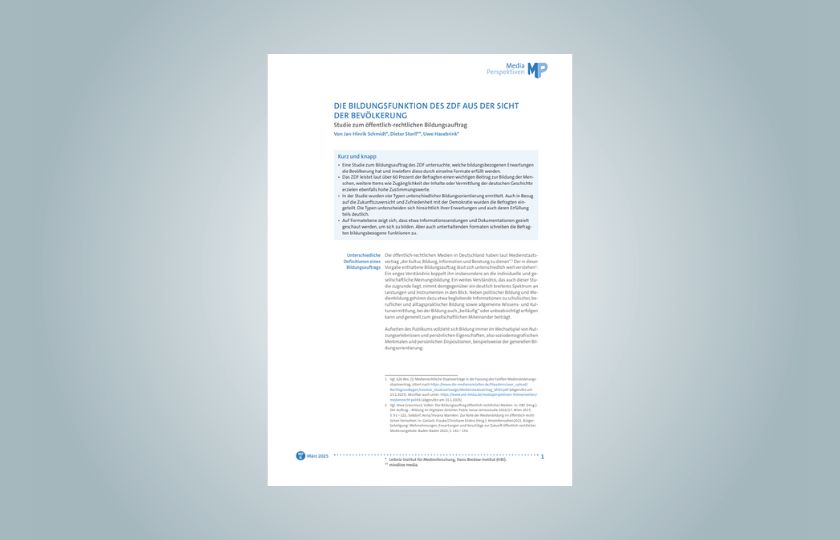
The Population’s View of ZDF’s Educational Function

A study on the educational mandate of the ZDF has for the first time examined the population's educational expectations and perceptions. Jan-Hinrik Schmidt, Uwe Hasebrink and Dieter Storll were involved in an advisory capacity in the design and evaluation of the study and have presented the core findings in detail in an article.

Portrait Michael Reiss
Congratulations

Communication on AI and Politics Awarded

Dr. Michael Reiss has been recognized for his outstanding communication on the topic of “AI and Politics” as part of the project “I'm a Scientist, Get me out of here!". Over a period of two weeks, about 350 students from 19 German-speaking schools in Germany and abroad exchanged ideas with 17 researchers on the influence of AI on political processes and democratic systems.

Auf schwarz-weißem Schachbrett stehen sich weiße und schwarze Figuren gegenüber
DAAD cooperation project

Mapping Polarization in News Media Content

How are polarizing topics reported in Germany and Australia – and does this reporting contribute to the polarization of political attitudes? The project examines how news content in both countries differs in its coverage of controversial issues – and whether this reporting contains potentially polarizing elements.

Cover of the Handbook Digital Journalism
Recently Published

Handbook of Digital Journalism

The second edition of the Routledge Companion to Digital Journalism Studies offers a collection of 54 essays addressing current issues and debates in the field of digital journalism studies, including two articles by Julius Reimer / Wiebke Loosen and Lisa Merten.

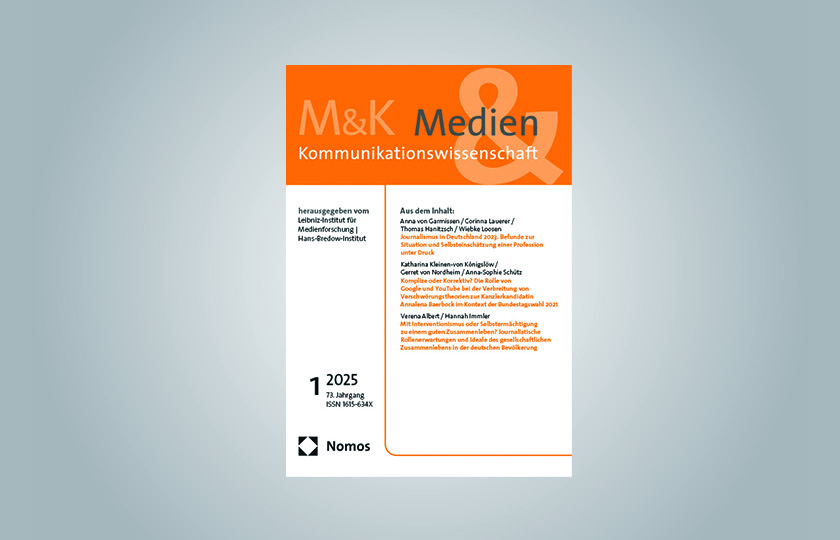
Cover von Heft 1/2025 der Zeitschrift M&K
Available Open Access

Issue 1/2025 of M&K Published

Issue 1/2025 of our journal Media & Communication Studies (M&K) has been published, including articles on journalism in Germany in 2023, on the role of Google and YouTube in the dissemination of conspiracy theories, and on journalistic role expectations and ideals of social coexistence in the German population. All content can be downloaded for free from the Nomos eLibrary.

Cover of the journal Computational Communication Research
Open Access Article

Data Donations from Journalism

In their article “I Really Thought I Would Use More Than Just Google: Investigating Professional Journalistic Online Use with Browser History Donations”, Lisa Merten, Felix Victor Münch and Maren Schuster describe how the method of data donation can be used to investigate professional media use in journalism. The article was published in the open access journal Computational Communication Research.

Gruppenbild mit Judith Möller, Wolfgang Schulz und Kristina Hein
Personnel Matter

Judith Möller Appointed to the Board of Directors at the HBI

Prof. Dr Judith Möller will be the new director of the HBI from March 2025. This was decided by the Institute's Board of Trustees on 20 January 2025. Judith Möller holds the Chair of Empirical Communication Research, especially Media Use and Social Media Effects, which the HBI established together with the Universität Hamburg. With her appointment, she also becomes a member of the Foundation's Board of Trustees, which currently consists of Director Prof. Dr. Wolfgang Schulz and Commercial Director Kristina Hein.

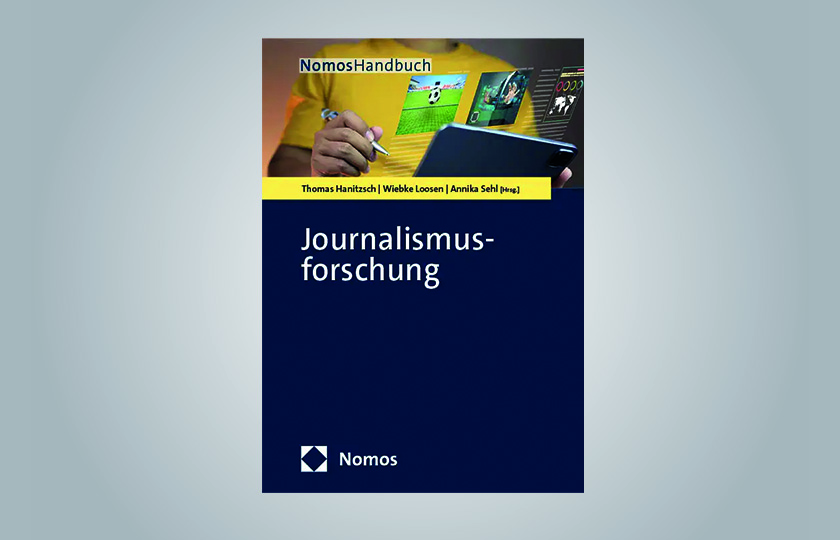
Cover des Nomos-Handbuchs Journalismusforschung
Recently Published

Journalism Research

A new Nomos Handbook, edited by Thomas Hanitzsch, Wiebke Loosen and Annika Sehl, offers an insight into the diversity of research on journalism in its social context. It looks, among other things, at actors, organisations and institutions, as well as at news, how it is produced and how it is used. The volume reflects the thematic, theoretical and methodological diversity of research.

Portrait Jan-Ole Harfst
Blog Post on Verfassungsblog

Elections in a Fortified Platform Democracy

The integrity of the German parliamentary elections and future European elections has been and continues to be threatened by influence peddling via social networks. The Digital Services Act (DSA) is supposed to provide a remedy against election manipulation. In a blog post on the Verfassungsblog, Jan-Ole Harfst explains why Art. 34-35 of the DSA could hardly remedy the systemic risks of this federal election campaign.

Portrait Judith Möller
Article in Vogue Magazine

The Role of Social Media in Political Education

What opportunities and risks does social media pose for political education, especially during election campaigns? Prof. Dr. Judith Möller gave an interview to Julia Stelzner in the magazine “Vogue” and referred to her research at the HBI.

Deutschlandkarte auf dunklem Hintergrund
RISC Blog Article

Elon Musk, the AfD and the Agenda-Setting of the Radical Right in the 2025 German Federal Election

The article explains how Elon Musk's communication interventions increase the media presence of Alice Weidel and the AfD, and how these dynamics are driven by the mechanisms of the digital attention economy.

Cover der Zeitschrift "Youth and Society" Ausg. 1/2025
Article in the Journal Youth & Society

Information and Political Engagement Practices of Disadvantaged Youth

In the study “Disinterested and Disillusioned? Information and Political Engagement Practices of Young People from Disadvantaged Backgrounds”, the information and participation practices of young people with a low level of formal education are examined.

1 … 13 14 15 16 17 … 43

Page 15 from 43

Newsletter

Information about current projects, events and publications of the institute.

Subscribe now