Growing Up in Digital Media Environments

How are the advancing digitalisation and deep mediatisation changing the way children and young people grow up? What role do social media, online platforms, and artificial intelligence play in identity development, education and social participation? And how can safe online spaces in which young people gain experiences be designed for young people?

The Research Area “Growing Up in Digital Media Environments” investigates how young people use digital and AI-powered media in their everyday lives, what opportunities and risks arise from this use, how they cope with the challenges of the digital world, and what implications this has for media education, children’s rights, and the protection of children and young people in digital media environments. A key characteristic of the research group is its interdisciplinary approach that brings together perspectives from communication studies, the social sciences and legal studies.

The research group pays particular attention to the changes brought about by data-driven systems and artificial intelligence and their implications for growing up in increasingly digitalised societies. In the Youth Lab (Y-Lab), it works together with children and young people in a participatory way: together, they explore new technologies and analyse experiences, expectations and patterns of use. Combined with established research methods, this approach provides a deeper understanding of the significance of digital media and AI-powered technologies for young people.

The planned Observatory for Young People in Digitised Societies will be designed to establish a long-term framework for research and monitoring, enabling the analysis of digital transformation and their consequences for young people. It draws together interdisciplinary findings from relevant studies and projects, including the group’s own research, identifies emerging developments and trends, and provides scientifically grounded knowledge for policymakers and society, supporting the further development of media education and the protection of children and young people in digital media environments.

Research group leaders: Dr. Stephan Dreyer and Dr. Claudia Lampert
Overview

Last update: 16.09.2026

Blog Articles, News, Projects, Publications, Podcast Episodes

Johanna Sebauer
Congratulations!

Two prizes for Johanna Sebauer

Johanna Sebauer won two awards at this year's Bachmann competition with her highly comical text "Gurkerl": the 3sat Prize (7,000 euros) and the BKS Bank Audience Award, endowed with 7,000 euros plus a 6,000 euro city writing scholarship in Klagenfurt, Austria.

Hand tippt auf Smartphone
How do software systems affect user behavior?

Software Systems, the Public and Participation

The aim of this project is to develop a communication-sociological approach to the relationship between software systems, the public sphere and participation.

Fußspuren im Sand
Collaborative Project

Information Environments Online and the Polarization of Political Opinions

What is the interplay between the diversity of our information exposure online and the polarization of our political opinions towards certain issues or groups over time?

Lichtinstallation: Weiße Quader schweben in dunkelblauem Raum
Volkswagen Foundation Funds Joint Project

Informing Regulatory Reasoning on Algorithmic Systems in Societal Communication with STEAM

The project, which is located between media law and computer science, aims to use a new method to visualize the functioning of news distribution on digital platforms and thus offer media regulation opportunities for new regulatory approaches.

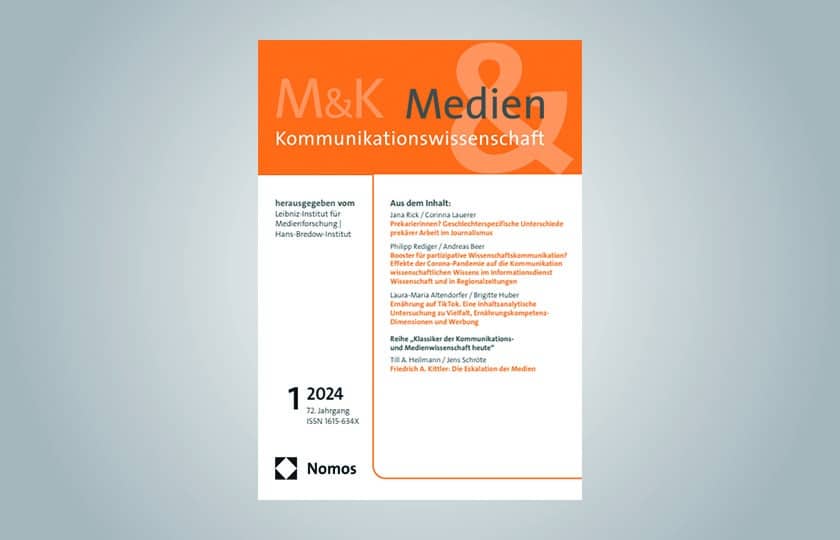
Cover M&K 1/2024
Issue 1/2024 M&K published

Issue 1/2024 M&K published

All content of M&K is available open access in the Nomos-Verlag eLibrary.

Äpfel in einer Sortiermaschine
New Methods in Automated Content Analysis

Few-Shot Learning in Communication Science

The cooperation project transfers computer science methods to empirical communication science. Semi-automated content analyses can thus also examine vast amounts of data.

KI geniertes Bild von einer jungen Frau, die mit einer jiungen Ärtzin am Tisch vor einem Tablett sitzt und beraten wird
Health Communication

Fertility and Ethics in Oncology

On behalf of the German Cancer Aid, this cooperative project investigates how younger patients with newly diagnosed cancer can be optimally counseled in dealing with fertility issues.

Schloss Schwerin
Telephone Survey

Media Use and Political Culture in Mecklenburg-Western Pomerania

The study aims to provide an overview of politically oriented media use and political culture in Mecklenburg-Vorpommern as well as to develop strategies to improve outreach to population groups that largely avoid news.

Zeitung, Notizbuch mit Stift, Mobiltelefon, Kaffeebecher und Sonnenbrill auf einem Holztisch
International Study on News Usage

Reuters Institute Digital News Report

The annual international representative survey conducted by the Reuters Institute in Oxford examines news usage and reveals general trends and national characteristics of developments. The Leibniz Institute for Media Research is conducting the German part of the study.

Mensch steht auf grauem Grund in der Mitte einer runden Spielfeldmarkierung. Er wirft einen langen Schatten.
Human in the Machine

Human In the Loop? Autonomy and Automation in Socio-Technical Systems

The research project Human in the Loop? investigates how human participation can improve automated decision-making processes.

Dunkler Serverraum
For a Secure Data Exchange

Data Portal Right-Wing Extremism

A research data infrastructure is to be further developed for the "Data Portal for Research on Racism and Right-Wing Extremism".

Kunden an Blumenstand auf einem Markt
Project within the RISC

Integration-Related Remit and Functions of Public Service Media

Are public service media legally obliged to create social cohesion? And how is the integration-related performance of these media perceived?

1 … 21 22 23 24 25 … 43

Page 23 from 43

Newsletter

Information about current projects, events and publications of the institute.

Subscribe now