
Media Research Methods Lab

The Research Group “Media Research Methods Lab” (MRML) supports the application of computer-assisted methods both within and outside the HBI through collaborative projects, its own methodological research, and the collection, processing, and provision of datasets.

In particular, the collection, processing, and provision of datasets will be expanded as part of the Digital Media Ecosystem Index (DIMEX) project, which will be launched in 2027 as part of the institute’s strategic expansion. In DIMEX, the infrastructure for collecting communications by public figures on social media and online media—which was already initiated with the Social Media Observatory (SMO)—will be systematically expanded, consolidated, and supplemented with structured reporting. The goal is to provide a regular overview of developments in the German social media landscape. DIMEX is complemented by content-based studies conducted as part of the SMO, particularly on polarization dynamics in selected social contexts.

As part of the DFG-funded research group “Communicative AI” (ComAI), we are entering the field phase of the project “Political Discourse: Communicative AI and Deliberative Quality” to test AI-based moderation and intervention strategies.

As part of the BMBF-funded project “Systematic Observation of New Auditory Risks” (SONAR), we are investigating how misinformation and disinformation spread via podcasts and short-form video platforms, as well as whether and how counter-narrative strategies—in the form of comments or response videos/audio clips—can sow doubt about the supposed certainties of widely circulated conspiracy myths.
Overview

Last update: 24.09.2026

Blog Articles, News, Projects, Publications, Podcast Episodes

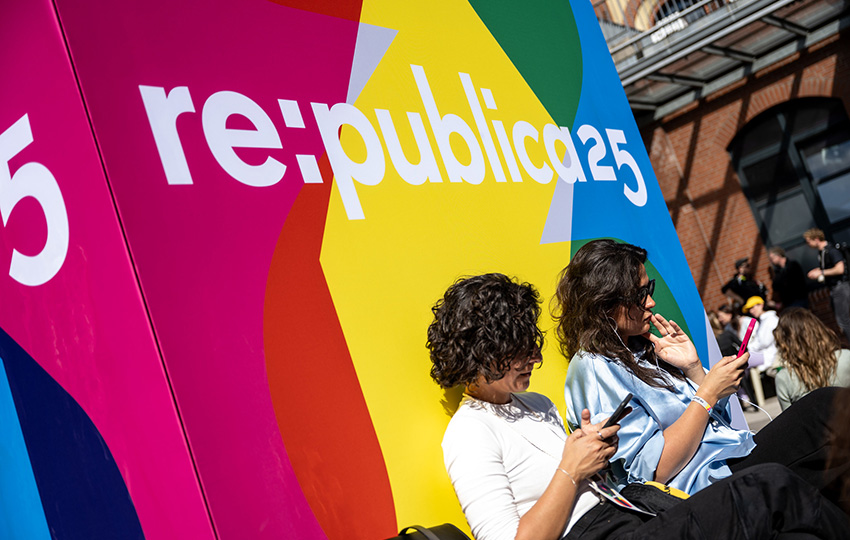
zwei junge Frauen sitzen auf ihr Handy blickend vor einem großen rot-gelb-grün-blauen Banner mit RePublica25-Logo
Presentations Available Online

The HBI at re:publica 2025

Jan Rau, Wiebke Loosen, Anna von Garmissen, Matthias Kettemann, and Katharina Mosene discussed new media actors, democratic discourse on platforms, and internet and AI regulation at re:publica25, which took place at STATION Berlin under the motto “Generation XYZ.” Recordings of the presentations are now available online.

Cover der Broschüre zum 75. Geburtstag
Brochure Available for Download

Facets of 75 Years Hans-Bredow-Institut

With this brochure. we take a look at the institute's development since 1950. While we do not claim to provide a complete history, we aim to highlight some of the institute's unique characteristics, showcasing moments in the past when these features were particularly evident.

Eine Gruppe junger Leute schaut auf ihr Handy
News Usage in International Comparison

German Findings of the Reuters Institute Digital News Report 2025

Trust in the news remains high in Germany. 45% of the adult online population believes that most news is generally trustworthy. At the same time, the majority of respondents believe that news produced by humans is more trustworthy than news generated by AI.

Cover des Arbeitspapiers "Für den Reuters Institute Digital News Report 2024  zur Nachrichtennutzung im internationalen Vergleich wurden zeitgleich Befragungen in 47 Ländern realisiert, um generelle Trends, aber auch nationale Besonderheiten erkennen zu können. Das HBI ist verantwortlich für die deutsche Teilstudie; es wird dabei von den Landesmedienanstalten und dem ZDF unterstützt.

Cover des Arbeitspapiers "Reuters Report 2025"
News Usage in International Comparison

Reuters Institute Digital News Report 2025 – Findings for Germany

The Reuters Institute Digital News Report 2025 examined news consumption internationally. To identify general trends and national characteristics, surveys were conducted simultaneously in 48 countries. The HBI conducted the German sub-study

Logo des Jubiläums: Der schriftzug 75 Jahre Medienforschung wird von buntem Konfetti umschwirrt
We Celebrate 75 Years of Media Research

From Radio to AI: Hans-Bredow-Institut Celebrates 75 Years of Media Research

The HBI is celebrating its 75th anniversary with a reception hosted by the Senate and a scientific event. Since the institute's founding in 1950, the media landscape has undergone significant changes. Through its research, the institute has kept pace with these changes and contributed to scientific development, as well as to the goal of providing relevant knowledge to politics, regulation, business, and civil society.

Leuchtende, von einer Decke hängende Lampen
New Leibniz Research Network

New Leibniz Research Network Strengthens Evidence-Based Science Communication

The Leibniz Research Network “Evidence-Based Science Communication” is set to counteract the increasing fragmentation of the research field from June 2025 onwards by strengthening the links between theory and practice. The HBI contributes its expertise in communication science to transfer research, including in the context of health communication.

Altes Zeitungsfoto von Hans-Bredow,
HBI 75: Founding History

How the Institute Got Its Name

On May 30, 1950, the Hans Bredow Institute was founded by the former Northwest German Broadcasting Corporation (the predecessor of NDR and WDR) and the University of Hamburg. This blog post describes the history of its founding and explains how the institute got its name.

Cover von Heft 2/2025 M&K
Recently Published

M&K 2/2025 Special Issue “Media Structures Revisited”

Issue 2/2025 of Media & Communication Science has been published as a special issue entitled “Media Structures Revisited,” edited by Josef Seethaler, Marlis Prinzing, Petra Herczeg, and Mark Eisenegger. The entire issue is available open access via the Nomos eLibrary.

Illustration Tortenstück mit TikTok Logo
Blog Dossier

Right-Wing Influence on the Internet

The Research Institute for Social Cohesion has published four blog posts examining the mechanisms, strategies, and platform dynamics that enable the radical right to gain media space, as well as ways to counteract this. Their analyses focus particularly on the TikTok platform.

Leonie Wunderlich hält ihren Doktorhut fest, der davonzufliegen droht
Successfully Completed Doctorate

Congratulations, Leonie Wunderlich!

Leonie Wunderlich has successfully defended her dissertation on “Information-Related Practises of Young People in the Hybrid Media System.” Congratulations, Leonie Wunderlich!

Portrait von Katharina Mosene (links) und Anna Schmidt
On air on Radio Alex

Katharina Mosene as a Guest on Anna Schmidt’s Radio Show

Katharina Mosene was a guest on Anna Schmidt's radio show on May 26, 2025. The show is broadcast weekly on Berlin radio station Alex. On the show, they discussed "Intersectional Feminist Approaches in the field of Internet Governance."

Portrait: Eva Luise Knor und Michael Reiss
Guest Article in epd medien

Curiosity and Skepticism. How AI is Used for Information Search

How is artificial intelligence (AI) used in Germany for searching political information? Are chatbots like ChatGPT replacing traditional media? Eva Luise Knor and Dr. Michael Reiss addressed these questions in their research project, "Generative Artificial Intelligence for Information Navigation." They present their findings in a guest article for epd medien.

1 … 11 12 13 14 15 … 43

Page 13 from 43

Newsletter

Information about current projects, events and publications of the institute.

Subscribe now