Media Research Methods Lab

The Research Group “Media Research Methods Lab” (MRML) supports the application of computer-assisted methods both within and outside the HBI through collaborative projects, its own methodological research, and the collection, processing, and provision of datasets.

In particular, the collection, processing, and provision of datasets will be expanded as part of the Digital Media Ecosystem Index (DIMEX) project, which will be launched in 2027 as part of the institute’s strategic expansion. In DIMEX, the infrastructure for collecting communications by public figures on social media and online media—which was already initiated with the Social Media Observatory (SMO)—will be systematically expanded, consolidated, and supplemented with structured reporting. The goal is to provide a regular overview of developments in the German social media landscape. DIMEX is complemented by content-based studies conducted as part of the SMO, particularly on polarization dynamics in selected social contexts.

As part of the DFG-funded research group “Communicative AI” (ComAI), we are entering the field phase of the project “Political Discourse: Communicative AI and Deliberative Quality” to test AI-based moderation and intervention strategies.

As part of the BMBF-funded project “Systematic Observation of New Auditory Risks” (SONAR), we are investigating how misinformation and disinformation spread via podcasts and short-form video platforms, as well as whether and how counter-narrative strategies—in the form of comments or response videos/audio clips—can sow doubt about the supposed certainties of widely circulated conspiracy myths.
Overview

Last update: 24.09.2026

Blog Articles, News, Projects, Publications, Podcast Episodes

Kugel mit unzähligen Portaitfotos darauf. Im Hintergrund, die Verdrahtungen einer Festplatte.
World's Largest Journalism Study

Journalism under Duress

As part of the world's largest journalism study, "Worlds of Journalism", this representative survey examines the profession of journalism and explores the stresses and strains faced by professional journalists in Germany.

Cover: Can Platforms cancel Politicians?
Platform Regulation

Can Platforms Cancel Politicians?

This working paper examines how political actors are treated on private online platforms in 15 European countries. It was published by Martin Fertmann and Matthias C. Kettemann as part of the Global Digital Human Rights Network Paper Series and is available free of charge as open access.

Wooden judge's gavel against a dark background
Platform Governance

Making Courts Count in Global Content Governance

Technological change poses new challenges for courts, while their decisions and the quasi-judicial structures of digital platforms increasingly shape the rules of digitality.

Cover: Content Analyses of User Comments in
Journalism A Systematic Literature Review
Spanning Communication Studies and Computer
Science
Article in Digital Journalism

Content Analyses of User Comments in Online Journalism

In their article, Julius Reimer, Wiebke Loosen, and Lisa Merten, together with Marlo Häring and Walid Maalej, present a systematic literature review on the content analysis of user comments in a journalistic context.

Media Research Blog

Trump’s social media ban

Trump’s ban from social media, while gaining significant media attention, does not represent an isolated case. Preventing individuals from accessing social media platforms or parts of them is a common phenomenon today. Edoardo Celeste terms it ‘social media exclusion’ and argues that it is possible to distinguish three types of this phenomenon on the basis of the actors and specific underlying factors determining the users’ exclusion.

Martin Fertmann
Post on the JuWissBlog

Censorship or Self-Defense? On the Blocking of Opposition Media in Ukraine

Martin Fertmann and Leif Thorian Schmied write on the “Junge Wissenschaft im Öffentlichen Recht” blog about the shutdown of three pro-Russian television stations in Ukraine. The stations were banned by decree—without a court proceeding—through a joint decision by President Zelenskyy and the National Security and Defense Council.

Logo Verfassungsblog
Twitter in India

Twitter’s Modi Operandi

In their post on the Verfassungsblog, Sangeeta Mahapatra, Martin Fertmann, and Matthias C. Kettemann write about the recent dispute between Twitter and the Indian government and its impact on human rights in India.

Cover des Arbeitspapiers Normative Leitbilder
Working Paper Nr. 54

Normative Principles of the European Media Regulatory Framework

In conjunction with Germany’s EU Council Presidency in the second half of 2020, the HBI prepared several reports intended to serve as a basis for discussion at the EU Media Conference in the second half of 2020.

Cover eines Online-Artikels auf dem Innovationsblog der dpa.
dpa Innovation Blog

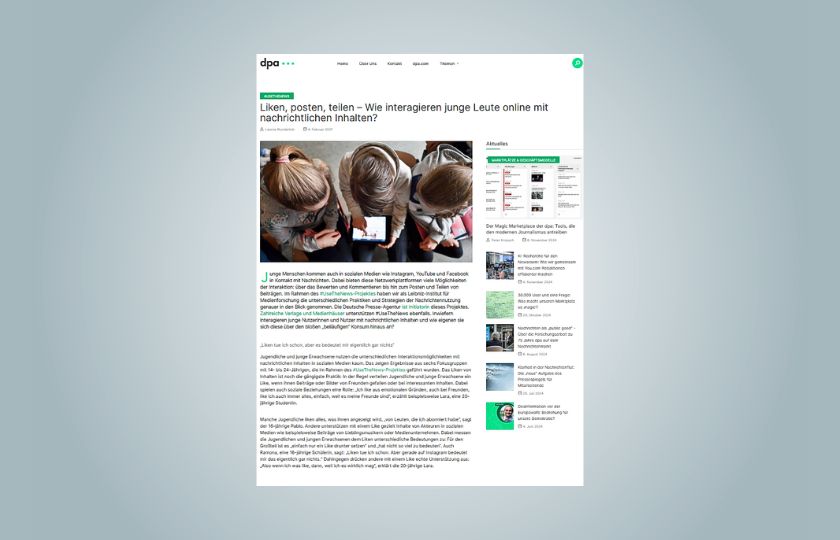
Likes, Posts, Shares – How Do Young People Interact Online with Newsworthy Content?

In the dpa Innovation Blog, Leonie Wunderlich explains the extent to which young social media users are exposed to news content and to what extent this exposure goes beyond mere “casual” consumption.

Cover der Publikation "Onlineberatung bei sexualisieter Gewalt in Kindheit und Jugend - wie geht das"
Children's Privacy

Particular Data Protection Requirements in Online Counselling of Children and Adolescents

Stephan Dreyer discusses data protection requirements for online counseling of minors in an article in the online brochure “Online Counseling for Sexualized Violence in Childhood and Adolescence,” published by the BKSF (Federal Coordination of Specialized Counseling Services Against Sexualized Violence in Childhood and Adolescence).

Jan Rau
Blog Article

The Far-Right on the Rise – What Germany Needs to Learn from the Capitol Siege

A mob of rioters supporting Donald Trump stormed the U.S. Capitol to disrupt the counting of electoral votes and the certification of Joe Biden’s victory. On his blog, Jan Rau writes about what Germany should learn from the storming of the Capitol.

Hans-Ulrich Wagner
Guest Editor Blog Series

Introduction ‘Harbour Cities’

In their blog article on Space and Culture, the two guest editors Hans-Ulrich Wagner and Justin Lloyd introduce their new blog series "Harbour Cities". It originated from the international network "Transnational Media Histories", a cooperation network of universities in Shanghai, Sydney and Hamburg.

1 … 33 34 35 36 37 … 44

Page 35 from 44

Newsletter

Information about current projects, events and publications of the institute.

Subscribe now