Opinion Formation

The “Opinion Formation” research group investigates how people can form their own independent opinions and what is required to make this possible on the part of lawmakers, society, the media, and online platforms.

Public opinion does not emerge in a single place or through a single actor. It emerges from a complex interplay among citizens, the media, platforms, politics, academia, civil society, businesses, and, increasingly, automated systems.

All of these actors pursue different goals, operate under different conditions, and influence in various ways which issues gain visibility and how they are evaluated.

Digitalization, platformization, and the use of artificial intelligence are raising classic questions about the democratic public sphere anew.

  • What is needed for people to form opinions freely and with full knowledge of the facts?
  • How do platforms change the visibility of information?
  • What are the consequences of disinformation, misinformation, and targeted manipulation?
  • And what responsibilities do the media, platforms, the state, and society bear?

Photo by Annie Spratt/Unsplash

Overview

Last update: 24.09.2026

Blog Articles, News, Projects, Publications, Podcast Episodes

Cover
Exam

Show Me Your Name and I’ll Tell You Who You Are!

In his contribution to the methodology section of the journal JURA - Juristische Ausbildung [Legal Education], Tobias Mast develops an advanced public law exam on fundamental rights and administrative procedural law.

Mehrere Menschen in einer U-Bahn, Zeitungen lesend.
Results of #UseTheNews-Study

Types of Information Orientation and Information Levels Among Young and Old News Audiences

Leonie Wunderlich and Sascha Hölig have examined how these patterns differ across and within three age groups and are investigating the connection to sociopolitical knowledge.

Cover der Publikation "The Law of Digital Globality"
Anthology

The Law of Global Digitality

A new anthology, co-edited by Matthias C. Kettemann, examines how the law regulates our digital future and how digital developments influence the law. It has been published as open access by Routledge.

Deckblatt des Arbeitspapiers "Stellungnahme zur Diskussionsentwurf zur Novellierung des Jugendmedienschutz-Staatsvertrages (JMStV)"
Written Statement

Discussion Draft on the Amendment of the Interstate Treaty on the Protection of Minors in the Media

Wolfgang Schulz and Stephan Dreyer have leveled sharp criticism at the draft proposal for a new State Treaty on the Protection of Minors in the Media. The concept of a “minor protection mechanism” at the operating system level presented in the draft appears to be very cumbersome and complex compared to the expected implementation and its effects.

Cover des Arbeitspapiers  Reuters-Bericht 2022
Report for Download

Reuters Institute Digital News Report 2022

For the report on news consumption in an international comparison, surveys were conducted simultaneously in 46 countries in order to identify general trends as well as national characteristics.

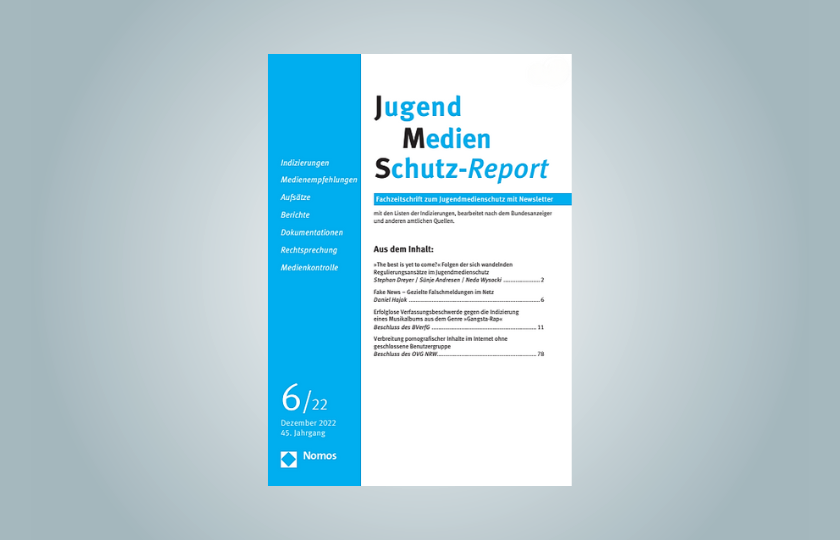
Cover:
Youth Media Protection Report 6/22

Changes in Regulatory Approaches to Youth Media Protection

In the latest Youth Media Protection Report, Stephan Dreyer, Sünje Andresen, and Neda Wysocki examine the systematic changes in statutory youth media protection and the resulting regulatory advantages in managing interaction and communication risks. They also highlight the implementation challenges that this regulatory area will face in the coming years.

Logo des Journals "Internet Policy Review"
Open Access!

 Truth, Intention and Harm. Conceptual Challenges for Disinformation-targeted Governance

Naomi Appelman, Stephan Dreyer, Pranav Manjesh Bidare, and Keno C. Potthast discuss conceptual challenges in the context of disinformation governance. In doing so, they highlight why the current focus on the truth or falsity of information and the intent to deceive entails both risks and uncertainties.

Logo des Journals "Internet Policy Review"
Open Access!

Between Evidence and Policy: Bridging the Gap in Disinformation Regulation

In this article, Pranav Manjesh Bidare, Dr. Stephan Dreyer, and Dr. Clara Iglesias Keller discuss the empirical evidence regarding the governance of disinformation. The article is part of a three-part series that presents key considerations regarding the regulation of disinformation.

Martin Fertmann
Governance of Disinformation

Hybrid Institutions for Disinformation Governance

In this article, Martin Fertmann, Bharath Ganesh, Robert Gorwa, and Lisa-Maria Neudert discuss the potential of new institutions for the governance of disinformation. The article is part of a three-part series that presents key considerations regarding the governance of disinformation.

Cover
Importance of Broadcasting Archives

Working on the Media Memory of Society

In his article published in info7 – Das Magazin für Medien, Archive und Information, Hans-Ulrich Wagner writes about the situation of public broadcasting archives and their importance for users as well as for authors working for broadcasters.  

Deckblatt des Artikels "Not all who are bots are evil: 
A cross-platform analysis of 
automated agent governance"
Article in "New Media & Society"

Not All Who Are Bots Are Evil

In their article in "new media & society", the authors examine how bots are regulated on nine platforms and develop an analytical framework to create a generalizable normative framework for agent governance.

Cover eines Artikels zur Studienlage
Overview of the Research Literature

Synopsis of Studies on News Use and News Literacy of Adolescents and Young Adults in Germany

Leonie Wunderlich and Sascha Hölig have published a review of the research on news literacy among adolescents and young adults in Germany on behalf of the Federal Agency for Civic Education. It was produced as part of the #UseTheNews project.

1 … 27 28 29 30 31 … 43

Page 29 from 43

Newsletter

Information about current projects, events and publications of the institute.

Subscribe now