
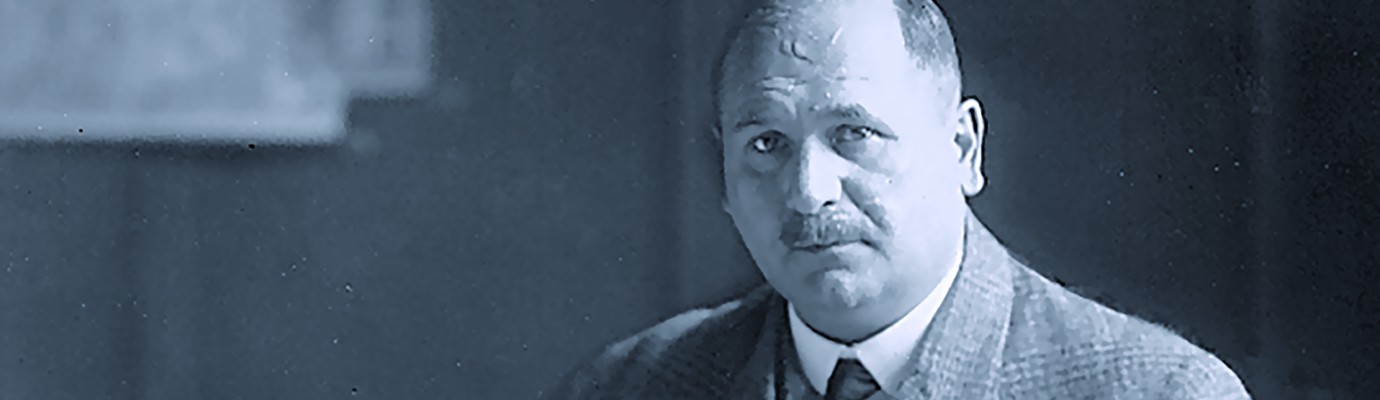
From the “Father” of Broadcasting to the “Unfit Father”: How the Press Covered Hans Bredow During the 1934–35 Broadcasting Trial
A search of the digital archives of the German Newspaper Portal reveals how quickly Hans Bredow’s image shifted from the “father” to the “unfit father” of broadcasting during the trial brought against him in 1934/35.
An article by Clara Schütze and Hans-Ulrich Wagner
Hans Bredow, the namesake of the Leibniz Institute for Media Research, resigned as Reich Broadcasting Commissioner on January 30, 1933, when the National Socialists came to power. At the time, many newspapers praised his achievements and referred to him as the “father of broadcasting.” Just a few months later, however, he was arrested, and in 1934/35, he stood trial alongside former directors and executives in the so-called “Great Broadcasting Trial.” The public prosecutor accused them of corruption and favoritism. The new National Socialist rulers sought to justify their actions against leading figures of the Weimar Republic’s broadcasting system, which they dismissed as “system radio”—and for them, Hans Bredow had already become the “unfit father” of radio. A search of the digital archives of the German Newspaper Portal provides insight into media coverage of broadcasting policy during the early years of the Nazi dictatorship.
Around 120 relevant articles on Hans Bredow—drawn from more than 3,000 search results—were examined in press archives from across Germany that have been digitized in the German Newspaper Portal. While these sources represent only a small portion of the newspapers published at the time, they nevertheless provide valuable insight into media coverage during this period.
Although the press could not be controlled as easily as radio during the early years of Nazi rule, due to its decentralized organizational structure, the Reich Ministry of Public Enlightenment and Propaganda, established in March 1933, sought to enforce and disseminate the policies of the National Socialist government. This included introducing new professional licensing requirements for journalists and publishers in October 1933, as well as increasing restrictions on and control over accessible sources of information through decrees and instructions issued in May 1933. As a result, it became increasingly difficult for opposition voices to be published.
Four distinct phases can be identified in media coverage of former State Secretary Hans Bredow—from his resignation and the scandal that led to his arrest, to the propaganda-driven staging of the opening of the broadcasting trial, which ultimately ended far less dramatically than expected.
Resignation as a Statement?
The historic turning point marked by the National Socialists’ seizure of power in January 1933 also had a profound impact on the life of Hans Bredow, who resigned from his influential position at the end of that month. Several newspapers reported on the news and, for the most part, expressed appreciation for his work. The Stadtanzeiger für Castrop-Rauxel (February 13, 1933) wrote that with his departure, “German radio loses a personality who has had a decisive influence on the development of radio broadcasting in Germany and throughout the world,” referring to Bredow’s long career in building the German broadcasting system.
While most reports cited “personal reasons” for his resignation, Buerische Volkszeitung (February 10, 1933) interpreted the move as “a demonstration by Bredow against the political instrumentalization of broadcasting.” According to the newspaper, he had “always endeavored to prevent personnel policy and programmingfrom becoming dependent on certain parties or ideologies” and, by resigning, showed that he was “not willing to work closely with the National Socialists.” These reports illustrate both the appreciation for Bredow’s achievements and the concern over attempts by Nazi officials to reshape broadcasting according to their own ideological vision.
Caught in the Crossfire of Corruption Allegations
>A few months later, in August 1933, newspapers were flooded with outraged reports of alleged corruption and embezzlement involving former broadcasting executives. The language used was strikingly harsh. Reports spoke of a “ cesspool of corruption” (Hamburger Tageblatt, August 2, 1933), “scandalous abuse” (Langenberger Zeitung, August 4, 1933), and “wasteful mismanagement” (Buersche Zeitung, August 4, 1933).
Hans Bredow was frequently mentioned alongside former colleagues accused of similar offenses as one of the “despicable profiteers and swindlers of the German people” (Biberacher Zeitung, August 21, 1933). They were said to have approved exorbitant salaries for one another, favored artists with whom they had personal connections, and financed private expenses with broadcasting funds. According to the Biberacher Zeitung, they were all part of a “community of crooks who blatantly and selfishly exploited listeners’ licence fees for their megalomaniacal taste for luxury.”
However, in many of these publications, Bredow himself became the target of direct personal attacks. The daily newspaper Aufwärts! (August 5, 1933), for example, claimed that he had “abused his position of power, built up under the Marxist regime, for his own irresponsible gain.”
The articles repeatedly invoked Bredow’s well-known designation as the “father of broadcasting” and turned it into a source of ridicule. Newspapers published scornful remarks such as “the child had to provide for the father” (Buersche Zeitung, August 4, 1933) and “the ‘father’ enriched himself from the achievements of the ‘child’” (Langenberger Zeitung, August 4, 1933).
These publications closely reflected the enforced conformity and “purge” campaigns initiated by Joseph Goebbels, the new Minister of Public Enlightenment and Propaganda. He was quoted as saying that he intended to “clean up ruthlessly, so that not even the smell remains in the radio stations” (Hamburger Tageblatt, August 2, 1933). This statement illustrates the marked escalation in tone that characterized all of the articles examined during this second phase.
Even editorial offices that had spoken favorably of Bredow at the time of his resignation – such as the Bergedorfer Zeitung and Buersche Zeitung – now adopted similar rhetoric. Bredow himself protested this treatment, demanding either the release of his arrested broadcasting colleagues or his own arrest. This demand appeared in several short reports under the headline “Bredow Also Wants to Go to the Concentration Camp,” including in the Deutsche Reichzeitung on August 9, 1933. His arrest at the end of October 1933 is likewise reported, with some newspapers describing him the “main person responsible in the radio affair” (Bergedorfer Zeitung, October 25, 1933).
A Grandly Stages Opening of the Trial
Although his name appeared only rarely in the analyzed press during the following year, interest in the alleged corruption does not seem to have subsided. When the “great broadcasting criminal trial” against Bredow and his colleagues—including Kurt Magnus, the former managing director of the Reich Broadcasting Corporation, and Hans Flesch, the former director of Berlin’s Funk-Stunde –began on November 5, 1934, public attention was considerable. Not only was there “a large audience” in the courtroom, but microphones were also installed on site, and parts of the proceedings were recorded on phonograph records. There were also plans to broadcast an edited compilation of these recordings on the radio—a propaganda measure, as the Pariser Tageblatt (December 14, 1934), published in France, speculated.
Accordingly, reporting on the first days of the trial was often highly detailed, even though it rarely made the front pages. The actual content of the proceedings, however, offered less material for sensational reporting than might initially have been expected. The trial focused primarily on economic and organizational aspects of the broadcasting organizations; political discussions appear to have played a lesser role or were explicitly excluded by the prosecution in some cases (Kölnische Zeitung, January 19, 1935). Bredow and his defense team emphasized and defended his achievements in building up broadcasting. He also continued to advocate the political neutrality of broadcasting: “My work is possible, especially in these difficult times, only if I can operate completely independently of any political party organization” (Kölnische Zeitung, January 19, 1935).
Assessments of Bredow as a person varied. Some publications alleged that he had “lined his own pockets, because [his] personal advantage was more important to him than the dutiful administration of his office” (Der Führer, November 3, 1934); others, by contrast, raised the question of how someone with such distinguished achievements could possibly have become involved in the dealings of which he was accused (Sächsische Volkszeitung, November 7, 1934).
In mid-December 1934, Reich Broadcasting Director Eugen Hadamovsky intervened, publishing an article under the headline “I Indict the System!” that was reprinted in numerous newspapers, including the Langenberger Zeitung (December 12, 1934). In an overtly aggressive and propagandistic tone, he condemned the “Bredow system”—the system “of political degeneration and the distribution of patronage, of Jewish intermarriage and cultural Bolshevism, of profiteering and a dividend mentality, of sabotage of the National Socialist uprising.” The “unfit fathers of broadcasting,” as Hadamovsky described Bredow, Flesch, and Magnus, had “ruined broadcasting in Germany for a decade.” The Pariser Tageblatt (December 14, 1934) again commented on these developments from exile, interpreting Hadamovsky’s article as an attempt, in response to the “failure of the broadcasting trial,” to belatedly create the propaganda effect of the show trial that had so far failed to achieve, by influencing public opinion and thereby putting pressure on the court.
A Surprisingly Quiet Conclusion
Nevertheless, public interest in the trial, which was still ongoing, waned over the following months. The microphones were removed, and, according to current knowledge, the recordings were never broadcast as an edited compilation, as originally planned. There was likewise considerably less reporting during this fourth phase, beginning in spring 1935, although shorter updates on milestones such as the prosecution’s sentencing request appeared from time to time. At the end of April, an article by NSDAP member and broadcasting commentator Heinz von Fehrentheil criticized the fact that the trial was proceeding too much according to the old “people-detached, liberal legislation” rather than according to National Socialist law. The article accused Bredow of sabotaging the National Socialists in broadcasting, although it attributed this primarily to economic rather than political motives (Unterschwäbische Tagespost, April 25, 1935).
The verdicts were published in mid-June 1935. Hans Bredow was sentenced to six months in prison and a total fine of 5,000 Reichsmarks for “public breach of trust, committed in four cases, as well as aiding and abetting the betrayal of a client by an attorney.” His entire sentence was deemed served by his time in pretrial detention.
According to press reports, the prosecutor in charge once again explicitly acknowledged Bredow’s achievements, while criticizing his positive relationship with Hans Flesch, who had Jewish roots. Bredow should have known that “in Flesch he was dealing with a personality who possessed all the makings of a swindler” (Hallische Nachrichten, April 25, 1935). In addition, the Kölnische Zeitung (June 14, 1935) devoted a paragraph to the stated aim of refuting the view expressed in the foreign press “that politically undesirable persons were to be put on trial here over nothing, solely for political reasons.” These statements suggest that corresponding reports about the broadcasting trial had appeared in foreign publications, although these could not be accessed through the sources used here.
Thereafter, the press fell silent about Hans Bredow. His name was mentioned only occasionally, for example to contrast the old “broadcasting system of corruption of Magnus, Bredow, Flesch and their associates” with the principles of the new National Socialist broadcasting system (Hakenkreuzbanner, December 17, 1935). Yet even such secondary references to the “old” broadcasting system disappeared in the following years. The partial overturning of the verdict in an appeal before the Reich Court in Leipzig in spring 1937 was reported only sporadically (Nationale Rundschau, March 1, 1937).
Between 1938 and 1944, the digitized holdings of the German Newspaper Portal contain no further reporting on Hans Bredow. The first evidence following the end of National Socialist rule dates from May 22, 1945. In Wiesbaden, where Hans Bredow had withdrawn, the US military government was overseeing the reconstruction of the administration: according to the report, Hans Bredow was appointed Regional President of Wiesbaden (*Eibenstocker Tageblatt*, May 22, 1945). Now 66 years old, he assumed political responsibility for a short time. Above all, however, he provided advice on the democratic reconstruction of broadcasting and was celebrated as the “father of broadcasting.”
Last update: 20.08.2026