Growing Up in Digital Media Environments

How are the advancing digitalisation and deep mediatisation changing the way children and young people grow up? What role do social media, online platforms, and artificial intelligence play in identity development, education and social participation? And how can safe online spaces in which young people gain experiences be designed for young people?

The Research Area “Growing Up in Digital Media Environments” investigates how young people use digital and AI-powered media in their everyday lives, what opportunities and risks arise from this use, how they cope with the challenges of the digital world, and what implications this has for media education, children’s rights, and the protection of children and young people in digital media environments. A key characteristic of the research group is its interdisciplinary approach that brings together perspectives from communication studies, the social sciences and legal studies.

The research group pays particular attention to the changes brought about by data-driven systems and artificial intelligence and their implications for growing up in increasingly digitalised societies. In the Youth Lab (Y-Lab), it works together with children and young people in a participatory way: together, they explore new technologies and analyse experiences, expectations and patterns of use. Combined with established research methods, this approach provides a deeper understanding of the significance of digital media and AI-powered technologies for young people.

The planned Observatory for Young People in Digitised Societies will be designed to establish a long-term framework for research and monitoring, enabling the analysis of digital transformation and their consequences for young people. It draws together interdisciplinary findings from relevant studies and projects, including the group’s own research, identifies emerging developments and trends, and provides scientifically grounded knowledge for policymakers and society, supporting the further development of media education and the protection of children and young people in digital media environments.

Research group leaders: Dr. Stephan Dreyer and Dr. Claudia Lampert

Overview

Last update: 16.09.2026

Blog Articles, News, Projects, Publications, Podcast Episodes

Cover
Legal Evaluation

Press Code of the Baden Württemberg Police

Tobias Mast examines the “Press Code” of the Baden-Württemberg police and provides a legal assessment of the rules governing the relationship between the police, the public, and the media.

Cover des Arbeitspapiers Plattformregulierung
Working paper Nr. 61

Platform Regulation in the 2021 Super Election Year

The paper provides real-time data on how online platforms regulate communication, how laws and local standards interact, and how the platforms’ practices are changing in the shadow of EU regulation amid the German federal election.

Cover:
Dealing with COVID-19 Fake News

Much Ado about Little

In their contribution to a collection of papers published by “The Hague Program for Cyber Norms” and Leiden University, Matthias C. Kettemann and Martin Fertmann explain how disinformation about COVID-19 is being combated in Germany and what legal issues arise in this context.

Cover
Politicians on Social Media

Facebook and Twitter Use of Candidates in the 2021 Federal Election

In the current issue of "Media Perspektiven", Jan-Hinrik Schmidt describes how the candidates for the 2021 Bundestag election used social media.

Cover der "Communicatio Socialis",
Media Usage Practices and Feelings of Belonging

Media Use and Social Cohesion

Is there a connection between media usage patterns and feelings of connectedness to local, national, regional, or global communities? Hannah Immler and Sascha Hölig provide answers in the journal “Communicatio Socialis” based on analyses of secondary data.

Cover der Zeitschrift "Journal of
Article in the Journal of Information Policy

Competent Third Parties and Content Moderation on Platforms:

In their article, Amélie Heldt and Stephan Dreyer discuss content moderation and the potential of independent decision-making bodies on online platforms. It has been published as open access in the "Journal of Information Policy".

Cover
Anthology With Audio-Visual Quotations

Genuinely Staged: Historical Authenticity and Media in Modernity

In the edited volume, Hans-Ulrich Wagner, Christoph Classen and Achim Saupe, together with other scholars, examine how historical authenticity is constructed through media while showcasing an innovative open-access publication format featuring audiovisual citations.

Cover
Handbuch Computational Social Science

From Frequency Counts to Contextualized Word Embeddings: The Saussurean Turn in Automatic Content Analysis

Gregor Wiedemann and Cornelia Fedtke illustrate in their contribution to the "Handbook of Computational Social Science" the semantic shift of the term "gold pieces" in the context of hate speech in the German Facebook discourse.

Cover: Zeitschrift Media Perspektiven, 11/2021
News Consumption in Germany

Findings from the 2021 Reuters Institute Digital News Survey

In the latest issue of Media Perspektiven, Sascha Hölig and Julia Behre present current trends in news consumption in Germany. The article is based on data from the 2021 Reuters Institute Digital News Survey.

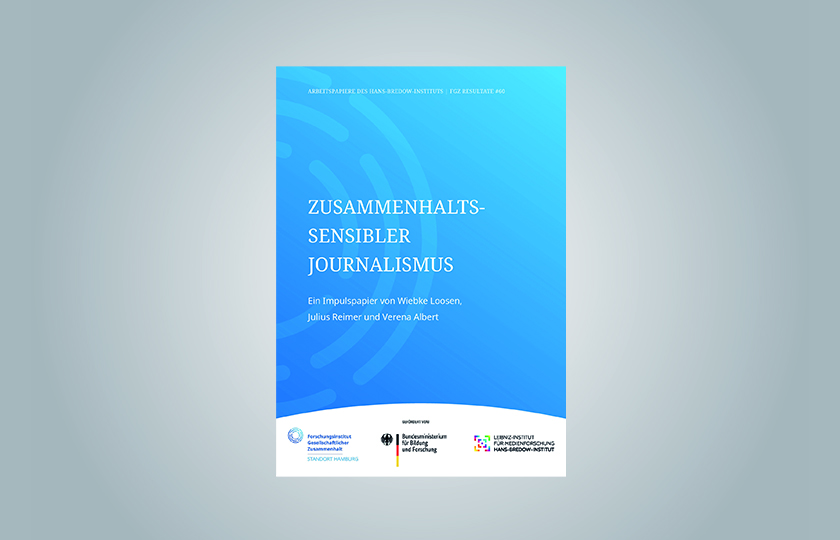
Cover des Arbeitspapiers Zusammenhaltssensibler Journalismus
Discussion Paper for Download

Cohesion-Sensitive Journalism

A research group at the HBI discussed the role of journalism in social cohesion with experts from the fields of journalism, academia, integration work, and NGOs.

Cover
Science Policy in Dialogue

Science Communication and Its Promotion from a Constitutional Perspective

In their article for “Science Policy in Dialogue,” a series published by the Berlin-Brandenburg Academy of Sciences and Humanities, Wolfgang Schulz and Keno C. Potthast discuss science communication in the context of legal protection and the need for regulation.

Empty rows of swivel chairs in a meeting hall or parliament chamber.
Platform Governance

Can Platforms Cancel Politicians?

An international study led by the HBI provides a first comparative overview of how societies and governments in 15 countries react to private power over political actors.

1 … 29 30 31 32 33 … 43

Page 31 from 43

Newsletter

Information about current projects, events and publications of the institute.

Subscribe now