Team Agile Formats

The Agile Formats team within Program Area 3—Science Communication, Agile Formats, and Library Services—started in 2026 as part of the institute’s strategic development. As a service- and knowledge-transfer-oriented unit, the team develops and supports innovative working formats that combine scientific expertise, interdisciplinary exchange, and societal knowledge transfer.

Working closely with the scientific program areas, the team designs and organizes formats such as Research Clinics, Sprints, and other collaborative and innovative working and knowledge-transfer settings. The goal is to make our scientific findings accessible to various target groups, including the scientific community as well as stakeholders from politics, the (media) industry, civil society, and professional practice.

The team is responsible for planning, facilitating, implementing, and following up on agile formats. This includes engaging external experts, developing working materials, and documenting and synthesizing the results. A particular focus is on communicating insights from these formats in a way that is tailored to the target audience and making them accessible through various media and knowledge transfer formats.

Through evaluation, feedback, and continuous improvement, the team helps to sustainably embed agile working methods at the institute and create new spaces for interdisciplinary collaboration, knowledge transfer, and societal impact.

Overview

Last update: 24.09.2026

Blog Articles, News, Projects, Publications, Podcast Episodes

Portrait Matthias Kettemann
Research Sprint Overview

When Scholars Sprint, Bad Algorithms Are on the Run

In the first research sprint of the project "Ethics of Digitalisation", funded by the Mercator Foundation, international researchers looked at the use of AI in the moderation of online content. Matthias Kettemann and Alexander Pirang provide an overview of the key findings in this blog article.

Portrait Matthias Kettemann
Facebook's Deletion Obligations in the Glawischnig Case

No “Censor for the World”

In an article on the Verfassungsblog [Constitutional Blog], Matthias C. Kettemann and his co-authors clarify misunderstandings in connection with the "Glawischnig ruling" of the Austrian Supreme Court.

Cover
Book Chapter

Hate Speech and Counter-Speech in Commentary of Mass Media Coverage

In a contribution to the anthology "Social Media", Gregor Wiedemann and Cornelia Fedtke examine the interplay between hate speech and counter speech on social networks. The authors propose a model for computer-aided critical discourse analysis.

Portrait Amélie Heldt, Matthias Kettemann
Article on Verfassungsblog

Why Platforms Struggle with Ensuring Data Access for Academics

In their article on the Verfassungsblog [Constitutional Blog], Amélie Heldt, Matthias C. Kettemann and Paddy Leerssen write about the difficulties of gaining access to platform data as researchers.

Cover der Publikation "The Third Better Internet for Kids Policy Map"
Third Edition

On November 30, 2020, the third edition of the “Better Internet for Kids” Policy Map study was presented at the Safer Internet Forum. In addition to the HBI, TU Dublin also contributed to the study, which was commissioned by the European Commission.

Cover
Open Access Article

Block, Hide or Follow

In this paper, Lisa Merten analyses how users curate their news consumption on social media by specifically following or blocking news accounts.

Cover
Austria's Communications Platform Act

Some Comments on Austria’s Draft Communications Platforms Act

Matthias Kettemann, Gregor Fischer and Felicitas Rachinger analyse the draft of the new Austrian Communications Platforms Act in the latest Graz Law Working Paper.

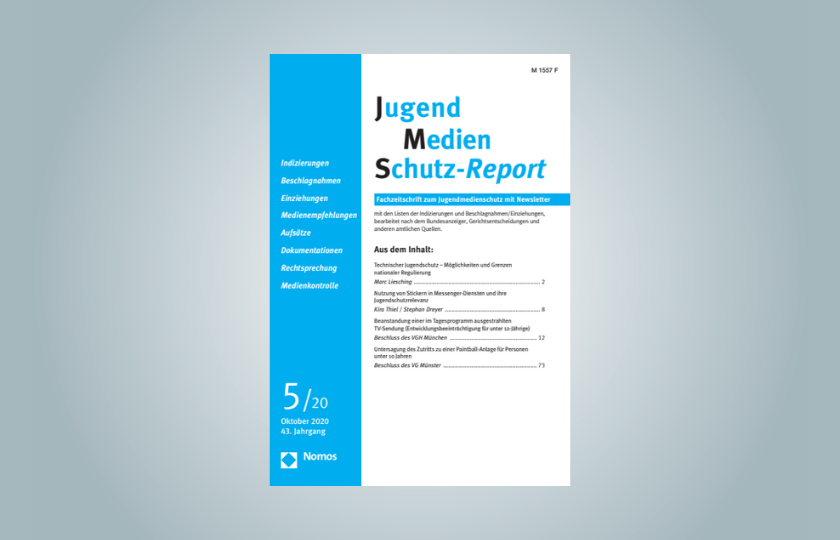
Cover der Zeitschrift Jugend Medien Schutz Report Ausgabe 5 / 2020
Protection of Minors in Messaging Services

Use of Stickers in Messenger Services and Their Relevance to Youth Protection

In the Youth Media Protection Report, Kira Thiel and Stephan Dreyer provide an overview of how children and adolescents use stickers in messaging apps and also discuss the associated risks.

Cover
Accompanying Text to Wolfgang Borchert

How Wolfgang Borchert’s “Draußen vor der Tür” Came to the Radio

Wolfgang Borchert's " Draußen vor der Tür [Outside the Door]" is a protest cry against the destructive power of war. After its first broadcast in 1947, it became the radio's biggest audience success in the post-war era. Hans-Ulrich Wagner contributed to the extensive booklet on the history of its creation.

Portrait Matthias Kettemann
Hate Speech Online

Comments on Austria’s Draft Communications Platform Law

On the Sustainable Computing Lab Blog, Matthias Kettemann analyses Austria's new Communication Platform Act. Although the Austrian legislator is already many things right with this "milestone" for more online protection but it still has a few edges.

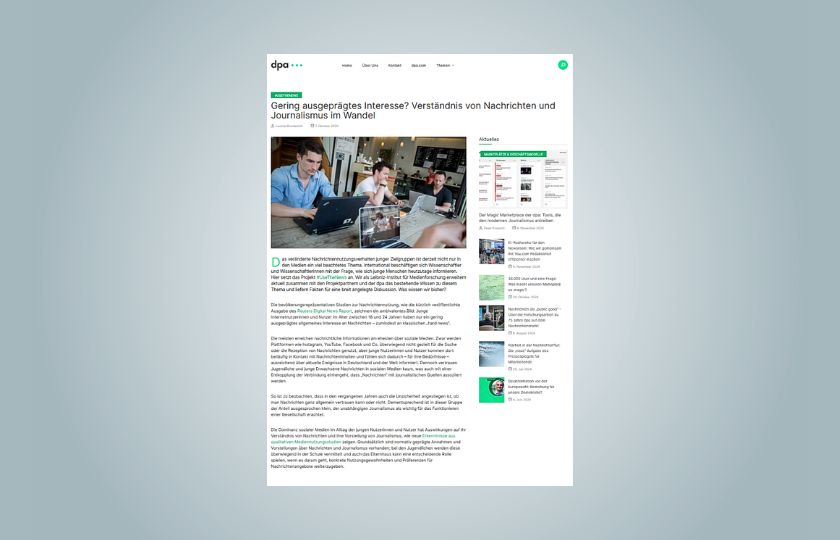
Vorschau eines Artikels auf dem Innovationsblog der dpa:
dpa Innovation Blog

In an article on the  innovation.dpa.com, Leonie Wunderlich writes about the first results of our project "Use The News" on news usage in the digital age.

Youth Media Protection

Not for the Faint Hearted?! How the Federal and State Governments Plan to Modernize Youth Media Protection

The Law on the Protection of Minors from Harmful Media is too old and calls for modernisation. In the current issue of the journal Kinder- und Jugendschutz in Wissenschaft und Praxis, Stephan Dreyer gives an overview of the planned changes, their points of friction and to what extent these changes can be sustainable.

1 … 33 34 35 36 37 … 43

Page 35 from 43

Newsletter

Information about current projects, events and publications of the institute.

Subscribe now