
Transformation of Journalism and the Public Sphere

The research group ‘Transformation of Journalism and the Public Sphere’ examines the transformation of journalism and the public sphere through an empirical and theory-driven approach – partly to understand what this means for democratic cohesion.

Journalism and the public sphere are emerging under new circumstances today: artificial intelligence is not merely intervening from the outside, but is becoming part of society’s communicative DNA. Language models help shape the narrative, platforms pre-sort content, and recommendation systems decide what reaches the public sphere in the first place – and this is shifting the way society communicates with itself.

One focus of the research group is on communicative AI: language models and automated systems have long since ceased to be mere tools; instead, they are themselves becoming participants in social communication. They intervene deeply in the structures through which the public sphere is formed. We analyse this reciprocal appropriation: how AI permeates communicative fields such as journalism, whilst at the same time being appropriated and integrated by people and organisations.

Another strand of our research examines the role that media and communication play in fostering – or jeopardising – social cohesion, and how the social order of understanding and media usage are changing in the digital age – supported by empirical evidence, for example through surveys on the cohesion-related services provided by public service broadcasters or participation in the qualitative panel of the Research Institute for Social Cohesion. Knowledge transfer is of particular importance here: we actively contribute our findings to public discourse and to dialogue with editorial teams, educational institutions and opinion leaders.

Our research is theory-driven, interdisciplinary, methodologically open, internationally networked – and consistently conducted through dialogue-oriented exchange with practitioners and the public. As part of the Worlds of Journalism Study (WJS), the world’s largest comparative study on the state of journalism, we contribute to international journalism research.

Overview

Leaders

Last update: 24.09.2026

Blog Articles, News, Projects, Publications, Podcast Episodes

Logo Verfassungsblog
Twitter in India

Twitter’s Modi Operandi

In their post on the Verfassungsblog, Sangeeta Mahapatra, Martin Fertmann, and Matthias C. Kettemann write about the recent dispute between Twitter and the Indian government and its impact on human rights in India.

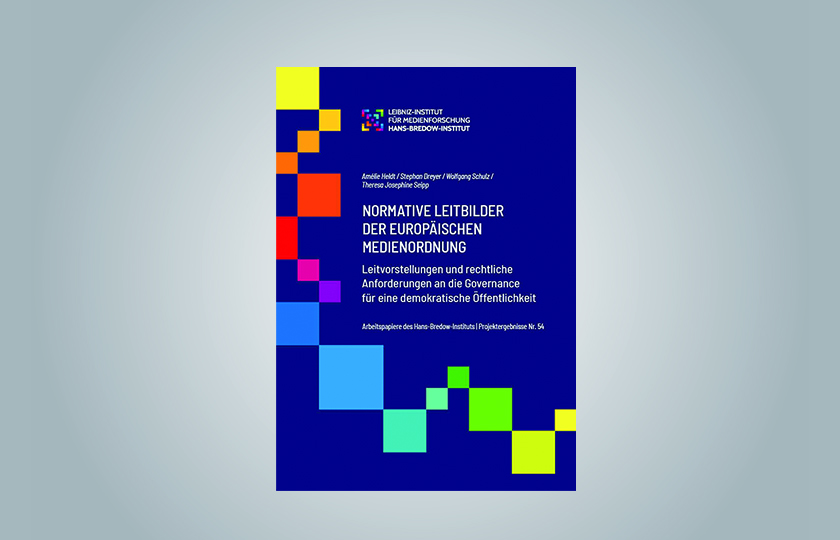
Cover des Arbeitspapiers Normative Leitbilder
Working Paper Nr. 54

Normative Principles of the European Media Regulatory Framework

In conjunction with Germany’s EU Council Presidency in the second half of 2020, the HBI prepared several reports intended to serve as a basis for discussion at the EU Media Conference in the second half of 2020.

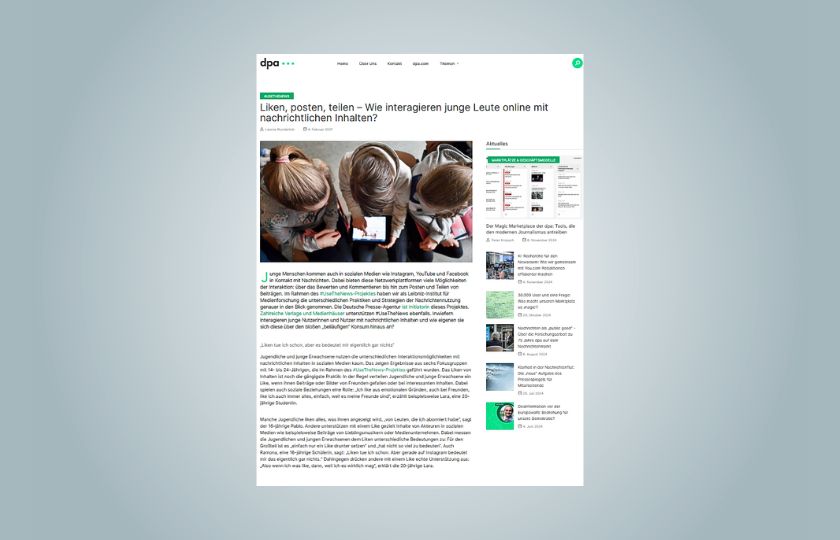
Cover eines Online-Artikels auf dem Innovationsblog der dpa.
dpa Innovation Blog

Likes, Posts, Shares – How Do Young People Interact Online with Newsworthy Content?

In the dpa Innovation Blog, Leonie Wunderlich explains the extent to which young social media users are exposed to news content and to what extent this exposure goes beyond mere “casual” consumption.

Cover der Publikation "Onlineberatung bei sexualisieter Gewalt in Kindheit und Jugend - wie geht das"
Children's Privacy

Particular Data Protection Requirements in Online Counselling of Children and Adolescents

Stephan Dreyer discusses data protection requirements for online counseling of minors in an article in the online brochure “Online Counseling for Sexualized Violence in Childhood and Adolescence,” published by the BKSF (Federal Coordination of Specialized Counseling Services Against Sexualized Violence in Childhood and Adolescence).

Jan Rau
Blog Article

The Far-Right on the Rise – What Germany Needs to Learn from the Capitol Siege

A mob of rioters supporting Donald Trump stormed the U.S. Capitol to disrupt the counting of electoral votes and the certification of Joe Biden’s victory. On his blog, Jan Rau writes about what Germany should learn from the storming of the Capitol.

Hans-Ulrich Wagner
Guest Editor Blog Series

Introduction ‘Harbour Cities’

In their blog article on Space and Culture, the two guest editors Hans-Ulrich Wagner and Justin Lloyd introduce their new blog series "Harbour Cities". It originated from the international network "Transnational Media Histories", a cooperation network of universities in Shanghai, Sydney and Hamburg.

Martin Fertmann
Incumbents and Social Media

Can Twitter ban Trump?

In their post on the “Junge Wissenschaft im Öffentlichen Recht” (Young Scholars in Public Law) blog, media law experts Martin Fertmann and Keno Potthast discuss whether Donald Trump’s Twitter ban marks a turning point in the previously privileged treatment of public officials on digital platforms.

Silhouettes of three people in front of a large American flag
Polarization in the US

Democracy at Stake: The Capitol Siege as a Digital Crisis?

The attack on the institutional heart of one of the oldest democracies of the world was a major shock, for the United States and democracies all over the world. How were social media conducive to the Capitol siege and what should we learn from it?

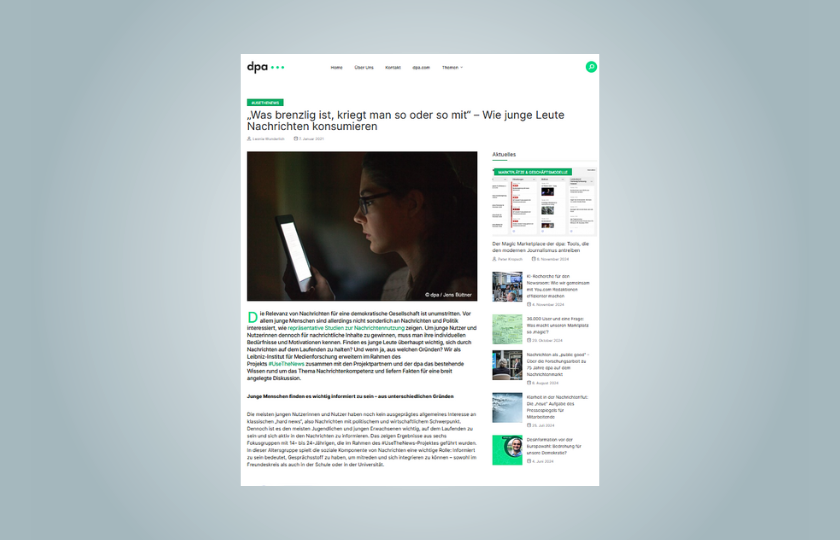
Vorschau des Artikels "Wie junge Leute Nachrichten konsumieren" auf dem Innovationsblog der dpa
dpa Innovation Blog

How Young People Consume News

Leonie Wunderlich writes about young people's news consumption in dpa's Innovation Blog. The article is based on results from our #UseTheNews project.

Daten auf einem Laptop. Quelle: Lukas Blazek, Unsplash
Telemedicus Article

State Media Authority v. Health-Related Google Knowledge Panels

In a guest article for Telemedicus, Martin Fertmann, Wolfgang Schulz, and Stephan Dreyer discuss whether collaborations between health authorities and online intermediaries are illegal.

Eine Frau liest eine Zeitung an einem Bahngleis.
Women and News

Women and News: An Overview of Audience Behaviour in 11 Countries

In “Women and News: An Overview of Audience Behavior in 11 Countries,” Julia Behre and Dr. Sascha Hölig share their findings from the 2020 Reuters Institute Digital News Report on women's news consumption in Germany.

Cover
Open Access

Media and Social Cohesion

The Research Institute Social Cohesion (RISC), in which the HBI is involved with five projects, has published its first publication. The anthology presents contributions on issues of social cohesion from all eleven German institutes and thus offers a first interdisciplinary look at this highly topical field of research.

1 … 32 33 34 35 36 … 43

Page 34 from 43

Newsletter

Information about current projects, events and publications of the institute.

Subscribe now