
Transformation of Journalism and the Public Sphere

The research group ‘Transformation of Journalism and the Public Sphere’ examines the transformation of journalism and the public sphere through an empirical and theory-driven approach – partly to understand what this means for democratic cohesion.

Journalism and the public sphere are emerging under new circumstances today: artificial intelligence is not merely intervening from the outside, but is becoming part of society’s communicative DNA. Language models help shape the narrative, platforms pre-sort content, and recommendation systems decide what reaches the public sphere in the first place – and this is shifting the way society communicates with itself.

One focus of the research group is on communicative AI: language models and automated systems have long since ceased to be mere tools; instead, they are themselves becoming participants in social communication. They intervene deeply in the structures through which the public sphere is formed. We analyse this reciprocal appropriation: how AI permeates communicative fields such as journalism, whilst at the same time being appropriated and integrated by people and organisations.

Another strand of our research examines the role that media and communication play in fostering – or jeopardising – social cohesion, and how the social order of understanding and media usage are changing in the digital age – supported by empirical evidence, for example through surveys on the cohesion-related services provided by public service broadcasters or participation in the qualitative panel of the Research Institute for Social Cohesion. Knowledge transfer is of particular importance here: we actively contribute our findings to public discourse and to dialogue with editorial teams, educational institutions and opinion leaders.

Our research is theory-driven, interdisciplinary, methodologically open, internationally networked – and consistently conducted through dialogue-oriented exchange with practitioners and the public. As part of the Worlds of Journalism Study (WJS), the world’s largest comparative study on the state of journalism, we contribute to international journalism research.
Overview

Leaders

Last update: 24.09.2026

Blog Articles, News, Projects, Publications, Podcast Episodes

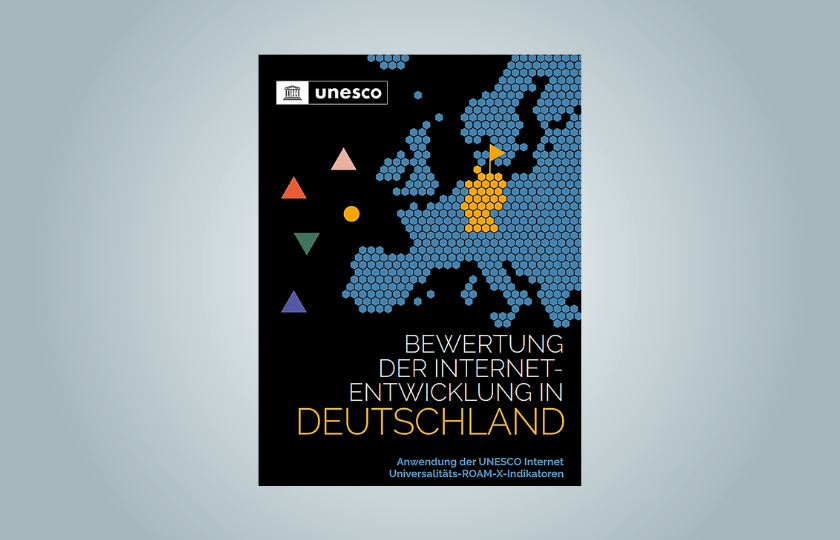
Cover der UNESCO-Publikation "Bewertung der Internetentwicklung in Deutschland"
Study commissioned by UNESCO

Assessing Internet Development in Germany

Overall, the state of the Internet in Germany can be assessed as good. This is one of the findings of a study on Internet development conducted by a team led by Prof. Dr. Wolfgang Schulz and Prof. Dr. Matthias C. Kettemann on behalf of the German National Commission for UNESCO.

Sticker showing a smiling man's face with the text 'MISS ME YET?' against a green background with yellow graffiti.

Twitter, Trump and The Taliban – The Need for Better Rules for Online Speech Governance

How come the Taliban have access to social media while former President Trump does not? The short answer is that Trump has deliberately violated the internal speech rules of social media companies before being banned while certain Taliban and Taliban-affiliated accounts have not done so recently or consistently. They are, however, often banned and/or suspended. But things are complicated.

Foto von Markus Spiske auf Unsplash: HTML-Codes
Article in the Journal of Legal Policy

Claim and Reality of Platform Regulation

In the Zeitschrift für Rechtspolitik (Journal of Legal Policy), Matthias C. Kettemann, Wolfgang Schulz, and Martin Fertmann ask whether the digital legal acts planned by the European Commission can live up to their own standards. The article is available to registered members in the beck-online database.

Cover des Arbeitspapiers Nr. 53
Working Paper No. 53

Media Use and School at the Time of the First Lockdown during the 2020 Covid-19 Pandemic

This report by Claudia Lampert and Kira Thiel provides an overview of how families in Germany experienced the lockdown period—particularly the transition from in-person to remote learning—and to what extent this changed their media usage.

Cover: Intermediaries vs. States or Intermediaries
Intermediaries and Freedom of Expression

Intermediaries vs. States or Intermediaries and States: Democracy in the Post-Intermediation Age

In their conference paper for the 2021 Weizenbaum Conference, Martin Fertmann and Matthias C. Kettemann write about intermediaries and freedom of expression. The conference paper was published as an open-access publication.

Publikation JF:Tech 10 Thesen zu Zukunftsthemen der Technikwissenschaften
People and Technology

10 Theses on Future Topics in the Technical Sciences for Sustainable Technology Development with a Focus on People

Matthias C. Kettemann, Martin Fertmann, Vincent Hofmann, and Mesut Bayraktar, together with Sissy-Ve Basmer-Birkenfeld, Regina Schönherr, and Anna Engelhardt, have authored “10 Theses on Future Topics in the Technical Sciences for Sustainable Technology Development with a Focus on People.” The article is available via open access.

Cover der Publikation "Autonomie und Verantwortung in digitalen Kulturen"
Open Access!

Attention Control by Social Media Platforms as an Intervention of Autonomy?

In their chapter, Stephan Dreyer and Amélie Heldt focus on privacy and the general right of personality in relation to algorithmic selection processes. They highlight where gaps exist and how these might be closed. The anthology has been published as an open-access publication in the Nomos eLibrary.

Facebook "f"
Blog Post on the Digital Society Blog

One Council to Rule Them All: Can Social Media Become More Democratic?

Martin Fertmann and Matthias C. Kettemann explain how social media governing bodies can help make platforms more democratic in their article “One Council to Rule Them All: Can Social Media Become More Democratic?” on the Digital Society Blog of the Alexander von Humboldt Institute for Internet and Society.

Cover des Arbeitspapiers Science Media Center
Working Paper Nr. 5

The Science Media Center Germany

Irene Broer and Louisa Pröschel took a closer look at the Science Media Center Germany and its role at the intersection of science and journalism. The results of their ethnographic study can be found here.

Hans-Ulrich Wagner
Blog Article

Siegfried Lenz: How the Author Uses the Media

On the blog of the Historical Commission of the ARD, Hans-Ulrich Wagner writes about how the author Siegfried Lenz used the media.

Cover: Jugendmedienschutzreport 6/2021
Assessment Under Criminal and Juvenile Protection Law

Online Sexual Harassment

From the perspectives of criminal law and juvenile protection law, authors Sünje Andresen and Stephan Dreyer examined forms of imposed sexuality and sexual harassment on the Internet.

Cover des Arbeitspapiers Gestaltung von Software
Working Paper Nr. 56

Legal Requirements for the Design of Software for Public Media Platforms

The working paper by Valerie Rhein, Stephan Dreyer, and Wolfgang Schulz outlines the current legal situation regarding software-based offerings by public media providers in Germany.

1 … 30 31 32 33 34 … 43

Page 32 from 43

Newsletter

Information about current projects, events and publications of the institute.

Subscribe now