
Transformation of Journalism and the Public Sphere

The research group ‘Transformation of Journalism and the Public Sphere’ examines the transformation of journalism and the public sphere through an empirical and theory-driven approach – partly to understand what this means for democratic cohesion.

Journalism and the public sphere are emerging under new circumstances today: artificial intelligence is not merely intervening from the outside, but is becoming part of society’s communicative DNA. Language models help shape the narrative, platforms pre-sort content, and recommendation systems decide what reaches the public sphere in the first place – and this is shifting the way society communicates with itself.

One focus of the research group is on communicative AI: language models and automated systems have long since ceased to be mere tools; instead, they are themselves becoming participants in social communication. They intervene deeply in the structures through which the public sphere is formed. We analyse this reciprocal appropriation: how AI permeates communicative fields such as journalism, whilst at the same time being appropriated and integrated by people and organisations.

Another strand of our research examines the role that media and communication play in fostering – or jeopardising – social cohesion, and how the social order of understanding and media usage are changing in the digital age – supported by empirical evidence, for example through surveys on the cohesion-related services provided by public service broadcasters or participation in the qualitative panel of the Research Institute for Social Cohesion. Knowledge transfer is of particular importance here: we actively contribute our findings to public discourse and to dialogue with editorial teams, educational institutions and opinion leaders.

Our research is theory-driven, interdisciplinary, methodologically open, internationally networked – and consistently conducted through dialogue-oriented exchange with practitioners and the public. As part of the Worlds of Journalism Study (WJS), the world’s largest comparative study on the state of journalism, we contribute to international journalism research.
Overview

Leaders

Last update: 24.09.2026

Blog Articles, News, Projects, Publications, Podcast Episodes

Cover des Arbeitspapiers Rechtsextreme auf Social Media
Report for Download

Online-Communication of the Extreme Right in Times of Crisis

The report sheds light on the current challenges posed by (digital) right-wing extremism in the context of the COVID-19 crisis and the 2021 federal election.

Cover
New Book

How Social Media Shape Political Action

How does social media change opinion-forming and political engagement? How do politicians use social media? Jan-Hinrik Schmidt addresses these questions in the newly published book.

Cover der Zeitschrift BzKJAktuell
Digital Media Environments

News Usage, Opinion Formation and the Orientation to Information of Young People

In their article in BPJMAKTUELL, Sascha Hölig and Leonie Wunderlich write about news use, opinion formation and the orientation of young people towards information in digital media environments.

Cover der Zeitschrift "merz", Ausgabe 2022/01.
merz Issue Focusing on Health

Digital Health Practices of Children and Young People

Claudia Lampert, together with Christa Gebel, served as content editor for Issue 2022/01 of the journal *merz | medien + erziehung*, which focused on the theme “Media and Health,” and authored an article titled “Digital Health Practices Among Children and Adolescents: Added Value or Risk?”

Cover: Abschlussreport "The Ethics of Digitalization"
Concluding Report

After two years of research into the ethical challenges of digitalization and strategies for addressing them, the international, interdisciplinary team of researchers has now published its final report. The team included Wolfgang Schulz, Matthias C. Kettemann, Martin Fertmann, and Vincent Hofmann.

Vorschau eines Artikels von Leonie Wunderlich
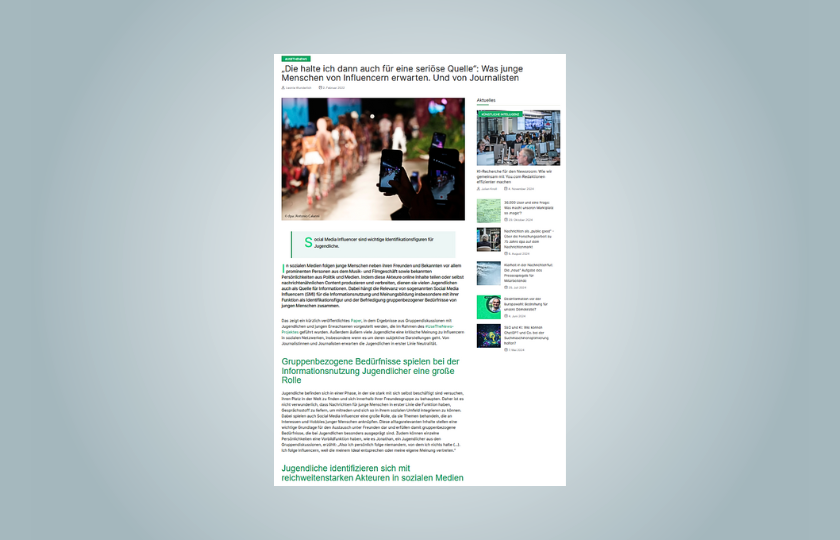
News Consumption

Young people are quite critical of influencers when it comes to their subjective presentation of newsworthy information. They expect journalists to be neutral above all. This is what the #UseTheNews study found out during group discussions with teenagers and young adults.

Deckblatt des Artikels "Not all who are bots are evil: 
A cross-platform analysis of 
automated agent governance"
A Model for Future Success?

The “European Strategy for a Better Internet for Children”: A Successful Model with a Future?!

Stephan Dreyer takes stock of the impact of the BIK strategy in the member states and the policy framework for children's online safety in Europe, and looks ahead to the future of the EU's plans in this area.

Cover der Publikation "Journalismus und Instagram"
Instagram instead of the news?

The Role of Social Media in News Usage. On Opportunities and Risks

An article by Sascha Hölig and Leonie Wunderlich highlights the role of social media regarding the use of news in an anthology on journalism and Instagram.

Cover des Arbeitspapiers
Statement

Written Opinion on the Discussion Draft on the Mission and Structural Optimisation of Public Service Broadcasting

Valerie Rhein, Stephan Dreyer, and Wolfgang Schulz welcome the states’ draft amendment to the State Media Treaty, which aims to further increase the flexibility of public broadcasting’s mandate and provide broadcasters with processes to further define that mandate.

Placeholder
#UseTheNews

The Role of Journalistic and non-Journalistic Sources in Young Peoples’ News Related Practices

Leonie Wunderlich, Sascha Hölig and Uwe Hasebrink write about journalistic and non-journalistic sources in young people's news consumption in their recently published article in The International Journal for Press/Politics.

Buchcover "Arbeitswelt und KI 2030"
Book chapter

Legal Requirements for AI Decisions in Administration and Justice

In this anthology, Johannes Schmees and Stephan Dreyer describe the current guidelines governing the use of artificial intelligence (AI) in public administration and the judiciary, and offer cautious reflections on the direction in which the government’s use of AI might evolve.

Cover
Article in Journal for Legislation

Publicity of Laws in the Age of Networking

Tobias Mast examines the constitutional significance of access to legal norms and develops proposals for a modern legal information portal based on database and search engine logics.

1 … 28 29 30 31 32 … 43

Page 30 from 43

Newsletter

Information about current projects, events and publications of the institute.

Subscribe now