
How do people obtain information in digital media environments—and what are the consequences for individuals, society, and democracy?
The Media Use and Societal Effects (MUSE) research group investigates how people use news and other information-related content, how these practices are changing in the wake of technological and societal shifts, and what impact this has on individuals, the public, and democratic societies.
Digital Information Environments
Our research focuses on digital information environments. These include traditional news outlets such as news websites and journalism apps, as well as social media, search engines, messaging services, generative AI, and other digital information sources. We examine not only news in the narrow sense, but also a broader spectrum of political and social information that people encounter in their daily lives. We are particularly interested in how the boundaries between journalistic, algorithmic, social, and AI-based information sources are shifting, and what role these different actors play in shaping citizens’ understanding of society.
Information-Use Practices
A key focus of our research is on information-use practices. We examine how people assemble their personal repertoire of information across various platforms, evaluate information, verify its credibility, and deal with conflicting information. This includes, for example, the use of social media for political information, the evaluation and validation of information from generative AI systems, and participatory forms of information engagement. We explore how people search for, select, share, comment on, and integrate information into their daily lives.
Furthermore, we are interested in how new information sources become established. We examine the adoption and use of new technologies, the role of digital media in the socialization of adolescents and young adults, and the conscious or unconscious non-use of news and other information sources.
We also examine the mechanisms of information evaluation and trust-building, as well as how people assess the quality and reliability of information in complex digital information environments.
Societal and Individual Impacts
The research group examines not only how information is used but also its consequences. We are particularly interested in issues of civic engagement, political participation, opinion formation, and democratic agency.
We analyze how digital information environments influence political attitudes and behaviors and what role they play in political polarization, political self-efficacy, trust in institutions, and social cohesion. In doing so, we investigate both the consequences of (a lack of) information and those of misinformation and disinformation.
At the same time, we examine the individual consequences of media use. These include issues of social and societal connectedness, information overload, a sense of social orientation, and the ability to navigate complex information environments.
Research Profile
Methodologically, we combine surveys, digital behavioral data, content analysis, qualitative studies, and computer-assisted methods to capture media use and its consequences as comprehensively and realistically as possible. A particular focus is on combining survey data with digital trace data to better understand actual media behavior and its effects.
Our research is conducted in close collaboration with national and international partners, including GESIS – Leibniz Institute for the Social Sciences, the University of Amsterdam, the University of Bremen, the University of Hamburg, Aalto University, the Reuters Institute for the Study of Journalism at the University of Oxford, Ludwig Maximilian University of Munich, Queensland University of Technology in Brisbane, and Friedrich Schiller University Jena.
Since 2013, we have been responsible for the German section of the Reuters Institute Digital News Report, one of the world’s most important comparative long-term studies on digital news and information use. Through this work, we provide key benchmarks on the development of news and information use in Germany and regularly contribute to the academic and public debate on the transformation of digital information environments.
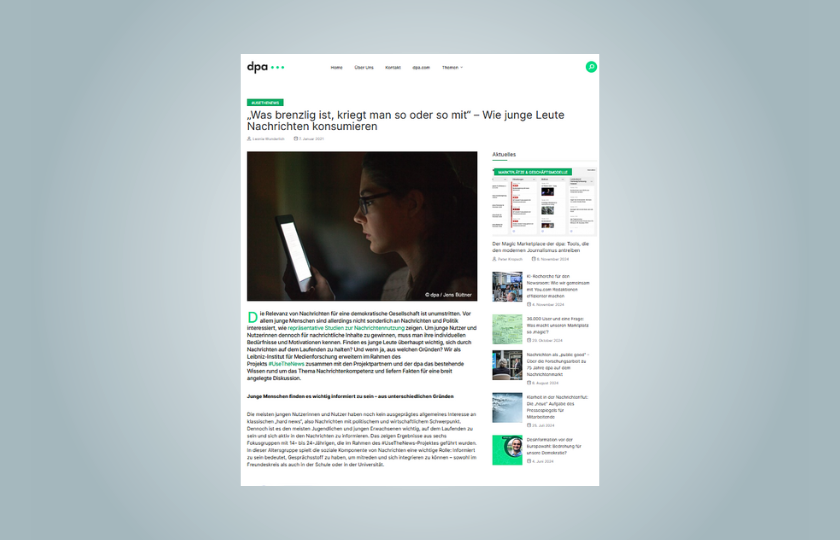
The research group also maintains close ties with stakeholders from the media industry, politics, education, and civil society. We regularly share our research findings through lectures, workshops, and consulting and collaboration projects with journalists and media organizations, including the German Press Agency (dpa), ARD and its regional broadcasters, ZDF, and Deutsche Welle. In addition, we engage in dialogue with policymakers and educational institutions. These collaborations not only facilitate the transfer of scientific findings into practice but also provide important impetus for identifying socially relevant research questions and further developing our research.
The work of the research group’s members has been published in leading international journals, including the *Journal of Communication*, *Communication Theory*, *Communication Research*, *Public Opinion Quarterly*, *The International Journal of Press/Politics*, *Digital Journalism*, *New Media & Society*, *Information, Communication & Society*, *Journalism*, *Journalism Studies*, *Journal of Computer-Mediated Communication*, *International Journal of Communication*, *European Journal of Communication*, *Journal of Broadcasting & Electronic Media*, *Social Science Computer Review*, and *Computational Communication Research*. Our research has been funded by the DFG, NWO, BMFTR, DAAD, the state media authorities, and ARD and ZDF.